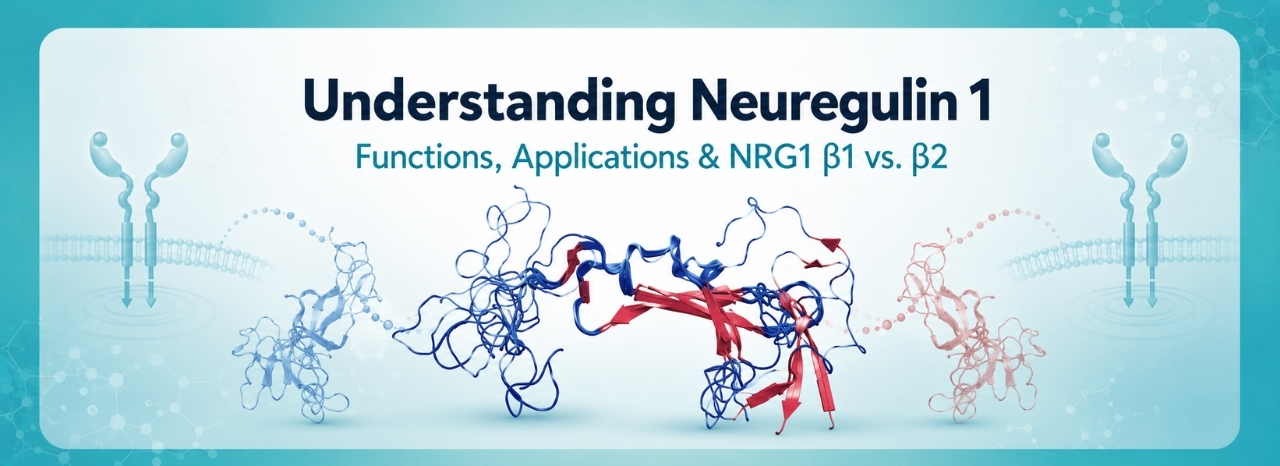
Understanding Neuregulin 1: Functions, Applications, and the Difference Between NRG1 β1 and NRG1 β2
A Comprehensive Guide to NRG1 Signaling and Isoform Selection
If you work in neuroscience, cardiac research, or oncology, you've likely come across Neuregulin 1 (NRG1). It is one of the most versatile signaling proteins in human biology, regulating everything from how our brain wiring stays intact to how cardiac muscle cells recover after injury.
However, diving into the scientific literature on NRG1 can get confusing quickly. With dozens of splice isoforms, broad receptor pathways, and subtle structural variations, it's easy to lose track of what each variant actually does.
In this post, we'll break down:
- What NRG1 is and its main physiological roles.
- How researchers and clinicians use NRG1 in experimental and clinical settings.
- The specific structural and functional differences between NRG1 β1 and NRG1 β2.
What is Neuregulin 1 (NRG1)?
Neuregulin 1 (NRG1) is a signaling protein that belongs to the Epidermal Growth Factor (EGF) family of extracellular ligands. It functions primarily by binding to ErbB receptor tyrosine kinases (specifically ErbB3 and ErbB4), which triggers receptor heterodimerization (typically with ErbB2) and activates downstream signaling cascades like the PI3K/Akt and MAPK pathways.
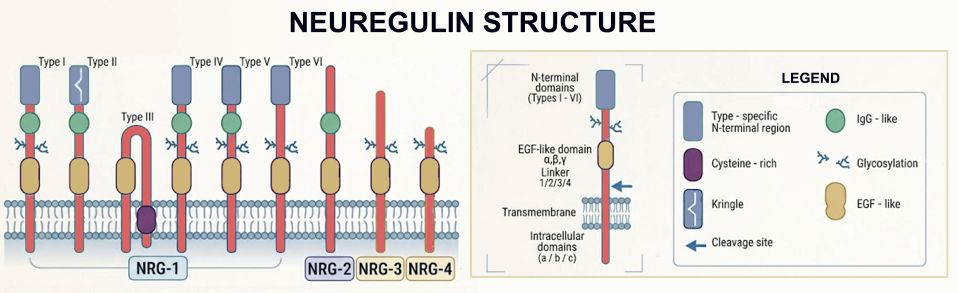
Because of alternative promoter usage and extensive mRNA splicing, the single NRG1 gene produces over 30 distinct protein isoforms. These isoforms are broadly categorized into six types (Types I through VI) based on their N-terminal domains, and further classified into α (alpha) and β (beta) variants based on their EGF-like domain structures.
Key Functions & Applications of NRG1
NRG1 acts as a crucial molecular messenger across several major organ systems:
1. Neurodevelopment and Synaptic Plasticity
NRG1 plays an essential role in the central and peripheral nervous systems:
- Schwann Cell Myelination: Type III NRG1 isoforms on axons tell surrounding Schwann cells to form the protective myelin sheath around nerves.
- Neuronal Migration & Synaptogenesis: It guides migrating neurons during brain development and helps balance excitatory and inhibitory synapses.
- Neuropsychiatric Relevance: Genetic variations in NRG1 and its receptor ErbB4 have been linked in genetic studies to schizophrenia and neurodegenerative conditions.
2. Cardiac Development and Repair
In the heart, NRG1 released by endocardial endothelial cells signals adjacent cardiomyocytes expressing ErbB2/ErbB4 receptors:
- Trabeculation: Essential for normal embryonic heart formation.
- Cardiomyocyte Survival & Regeneration: Recombinant human NRG1 (rhNRG1) promotes cardiac cell survival, structural reorganization, and pump function recovery, making it a major therapeutic candidate for heart failure.
3. Oncology and Drug Targeting
While normal NRG1 signaling is required for tissue repair, aberrant NRG1 signaling (such as NRG1 gene fusions) can drive unchecked cell proliferation in cancers like pancreatic, lung, and breast cancers. Inhibitors targeting ERBB2/ERBB3 dimerization or NRG1 fusion proteins represent an active area of precision oncology research.
NRG1 β1 vs. NRG1 β2: What's the Difference?
When ordering recombinant proteins or designing experiment protocols, you'll frequently see NRG1 β1 and NRG1 β2. Understanding how they differ helps ensure you choose the right reagent for your study.
Why β instead of α?
The β-variants of NRG1 contain an EGF-like domain that binds to ErbB receptors with 10 to 100 times higher affinity than α-variants. As a result, β-isoforms (like β1 and β2) drive significantly stronger biological responses and are the primary isoforms used in cell culture and preclinical assays.
The key differences between NRG1 β1 and NRG1 β2 come down to exon splicing in the linker region following the EGF-like domain:
Feature |
NRG1 β1 (Beta 1) |
NRG1 β2 (Beta 2) |
|---|---|---|
| Splicing Region | Includes C-terminal sequence encoded by exon 2 of the β-type region | Uses an alternative splice junction (exon 3) in the β-type region |
| Amino Acid Sequence | Unique C-terminal tail sequence directly following the EGF domain core | Alternate peptide sequence following the EGF domain core |
| Receptor targets | ErbB3/ErbB4 | ErbB3/ErbB4 |
| Proteolytic Cleavage | Standard shedding pattern by ADAM metalloproteases (e.g., ADAM17/TACE) | Slightly altered cleavage efficiency and cell-surface presentation |
| Primary Research Use | Most widely used standard for cell culture experiments (e.g., Schwann cell proliferation, stem cell differentiation, cardiac assays) | Used in specific isoform-comparative studies or targeted receptor interaction assays |
Key Takeaways for the Lab:
- Biological Activity: Both β1 and β2 bind ErbB3/ErbB4 receptors effectively and trigger robust downstream signaling.
- Reagent Availability: NRG1 β1 (specifically the EGF domain fragment) is the standard isoform supplied by major biological reagent vendors. Unless your study explicitly focuses on splice-variant specificity, β1 is usually the default choice.
- Local Context Matters: While their core signaling capabilities overlap significantly, slight differences in local tissue expression and proteolytic cleavage kinetics mean they can have non-identical half-lives or membrane-anchoring behaviors in living tissue.
Summary
Neuregulin 1 is a master regulator of cell-to-cell communication in the brain, heart, and tumors. While the NRG1 gene produces a complex family of proteins, using β-isoforms ensures high receptor binding affinity. For general cell culture and functional studies, NRG1 β1 remains the benchmark tool, while comparing β1 and β2 opens up valuable insights into isoform-specific regulation in disease models.
To support high-precision research across neuroscience and cardiovascular biology, ScienCell provides top-tier recombinant human proteins for both distinct isoforms:
- Recombinant Human NRG1 beta 1 (Cat #107-10b1): Ideal for standard Schwann cell proliferation, stem cell differentiation, and general ErbB receptor stimulation.
- Recombinant Human NRG1 beta 2 (Cat #107-10b2): Designed for comparative splicing studies, isoform-specific signaling assays, and targeted receptor binding research.


-beta-1-1.jpg)
-beta-2-1.jpg)