Fibroblast growth factor 2 (FGF-2), also known as basic fibroblast growth factor (bFGF), is widely used in cell culture and biomedical research. It supports cell proliferation, survival, migration, and differentiation across a broad range of cell types and applications, including primary cell culture, stem and progenitor cell culture, tissue engineering, and cell-based assays.
However, the biological performance of FGF-2 depends not only on how much protein is added to a culture system, but also on how much biologically active FGF-2 remains available to cells over time. This is where FGF-2 stability becomes an important consideration.
FGF-2 Stability Under Physiological Conditions
FGF-2 stability can become a significant challenge once the protein is placed under physiological conditions. Unlike storage conditions, where temperature and formulation can be carefully controlled, FGF-2 used in cell culture is typically maintained at approximately 37°C for extended periods. Experimental studies have demonstrated that FGF-2 can lose a substantial amount of its biological activity during incubation at 37°C. In one study, both human and zebrafish FGF-2 showed a dramatic loss of activity after 24 hours at 37°C. The loss of activity was associated with protein aggregation, while the presence of heparin helped preserve FGF-2 activity and reduce aggregation. This means that the amount of FGF-2 initially added to a culture medium may not accurately reflect the amount of biologically active FGF-2 available to cells later in the culture period. This effect can be particularly important in applications where cells depend on sustained FGF-2 signaling. In a study of human pluripotent stem cell culture, researchers found that FGF-2 levels in conventional culture conditions decreased by more than 50% within just a few hours and were barely detectable after 24 hours. These findings highlight a fundamental challenge: even when the initial FGF-2 concentration is carefully controlled, the effective growth factor environment can change substantially over time. The same principle is not limited to stem cell culture. Any cell-based application in which FGF-2 remains at physiological temperature for an extended period may be affected by changes in the availability of active protein.
Adding More FGF-2: A Practical Way to Compensate
One common approach to dealing with FGF-2 instability is simply to start with a higher concentration. If some FGF-2 becomes inactive during culture, maintaining a relatively high initial concentration can help keep the amount of active FGF-2 above a desired level for a longer period of time. Higher FGF-2 concentrations have, in fact, been used in some stem cell culture systems to compensate for the rapid loss of active FGF-2. However, increasing the starting concentration does not eliminate the underlying stability problem. The amount of active FGF-2 will still change over time. After fresh medium containing FGF-2 is added, cells may initially encounter a relatively high level of active growth factor. As FGF-2 loses activity, that level gradually decreases.
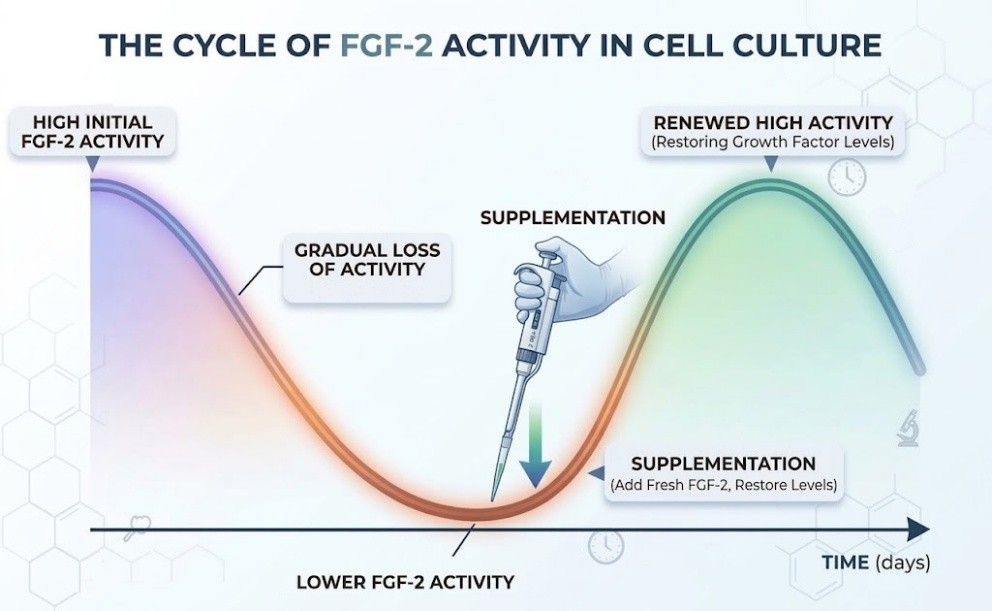
The concern is not necessarily that a higher FGF-2 concentration is inherently harmful to cells. Rather, repeated changes in the availability of biologically active FGF-2 can create a less consistent signaling environment.
For applications that depend on relatively sustained growth factor signaling, maintaining a more consistent level of active FGF-2 may therefore be preferable to repeatedly compensating for its loss.
Other Approaches to Maintain FGF-2 Activity
Heparin and Heparan Sulfate
Heparin and heparan sulfate can interact with FGF-2 and have been shown to stabilize the protein under certain conditions. In cell culture, these interactions can help protect FGF-2 from loss of activity and are particularly relevant to the biology of FGF signaling. This is one reason heparin or related components may be included in some FGF-2-based culture systems.
However, heparin does more than simply stabilize FGF-2. It can also influence FGF receptor interactions and downstream signaling. Therefore, its effects need to be considered in the context of the specific cell culture system.
More Frequent Supplementation
Another approach is to replenish FGF-2 more frequently. Rather than allowing the available FGF-2 activity to decline substantially, fresh FGF-2 can be added at shorter intervals. This can help maintain growth factor activity but also increases handling requirements and may introduce repeated changes in the culture environment.
Controlled Delivery
Controlled-release approaches can provide a more sustained supply of FGF-2 and reduce the sharp changes associated with conventional bolus supplementation.
These approaches can be useful in specialized applications, but they may also add complexity to the experimental system.
Addressing the Problem at Its Source: Thermal-Stable FGF-2
A thermally stable FGF-2 is designed to retain its biological activity more effectively under physiological-temperature conditions. Instead of relying primarily on higher starting concentrations, frequent supplementation, or additional stabilizing components, improving intrinsic protein stability addresses one of the underlying causes of activity loss.
This can be particularly valuable in applications where FGF-2 needs to remain active for extended periods after being added to a culture system.
More Consistent FGF-2 Activity
The goal of thermal stabilization is not simply to make FGF-2 “last longer.” More importantly, improved stability can help make the amount of biologically active FGF-2 more predictable during actual use. This distinction is important. For many growth factor applications, researchers control the concentration of the protein added to the medium very carefully. However, the nominal concentration alone does not tell the complete story. If the protein gradually loses activity at 37°C, the cells may effectively experience a changing growth factor environment even when no other experimental parameter has changed.
Improving FGF-2 thermal stability can help reduce this discrepancy between the amount of protein added and the amount of active protein available to cells.
Why Thermal Stability Matters
FGF-2 is used across a wide range of cell culture and research applications, and the importance of its stability will depend on the specific experimental system.
For applications requiring sustained FGF-2 activity, however, thermal stability is an important property to consider.
Stem cell culture illustrates the issue particularly well, but the underlying principle extends beyond stem cells: when a growth factor is exposed to physiological temperature for extended periods, its intrinsic stability can influence how much active protein remains available to the cells.
Rather than continually compensating for the loss of FGF-2 activity, improving the thermal stability of the protein offers a more direct way to support consistent FGF-2 performance during use.
For researchers working with FGF-2, stability is therefore not simply a property of the protein. It is an important part of how reliably that protein performs in a real biological system.
Beyond maintaining FGF-2 activity during use, thermal stability may also offer practical advantages:
- Reduce Costs: Less FGF-2 may be needed to compensate for activity loss, helping reduce overall reagent consumption and cost.
- Simplify Culture Conditions: Reduced reliance on heparin may help simplify FGF-2 supplementation, depending on the specific cell culture system.
- Reduce Hands-On Work: More stable FGF-2 may reduce the need for frequent medium changes or repeated FGF-2 supplementation, making routine cell culture more convenient.
Thermally Stable FGF-2 from ScienCell
For researchers looking to minimize the impact of FGF-2 activity loss during cell culture, improving the intrinsic thermal stability of the protein offers a direct approach.
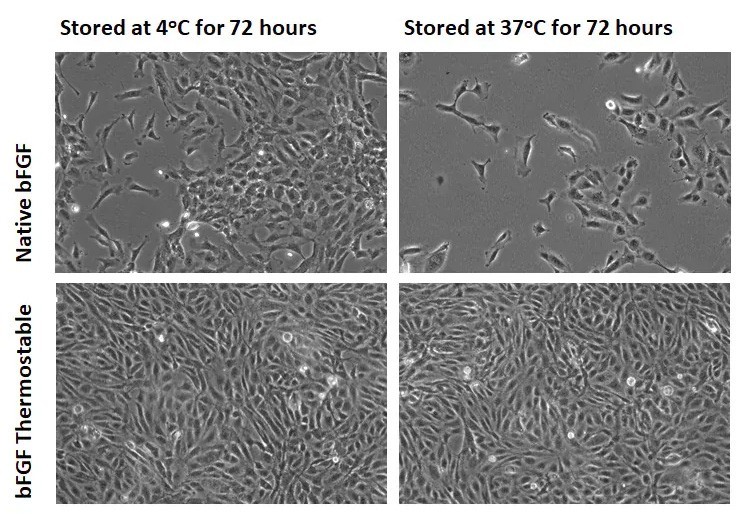
ScienCell provides thermally stable recombinant human FGF-2 (Cat No. 104-02ts). As shown in the data below, thermalstable FGF-2 showed a stronger effect on HUVEC proliferation than native FGF-2 following storage at either 4°C or 37°C. Notably, thermally stable FGF-2 showed comparable effects on HUVEC proliferation after storage at 4°C and 37°C.
For applications where consistent FGF-2 activity is important, thermally stable FGF-2 can help reduce the need to compensate for activity loss through higher starting concentrations or frequent supplementation, providing a more consistent growth factor environment during cell culture.