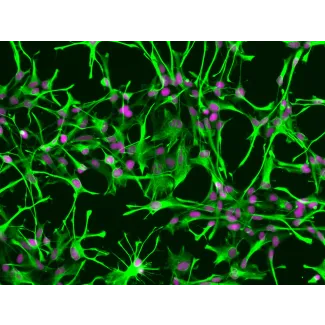

APOE genotype–specific astrocyte biology has emerged as a central driver of Alzheimer’s disease and neurodegenerative risk. Recent studies demonstrate that the APOE4/4 genotype profoundly reshapes astrocyte function across multiple pathways, including lipid metabolism, neuroinflammatory signaling, and synaptic support. APOE4 astrocytes show impaired cholesterol transport and lipid handling, heightened inflammatory and stress-associated states, and reduced capacity to support synapse formation and neuronal resilience compared to APOE3 counterparts. Collectively, these findings underscore that astrocytes are not passive responders, but active contributors to APOE-mediated disease mechanisms—making genotype-appropriate astrocyte models essential for mechanistic and translational research.
Why astrocyte genotype matters
Astrocytes play a pivotal role in maintaining brain homeostasis, regulating lipid trafficking to neurons, modulating immune responses, and supporting synaptic integrity. In the context of APOE4/4, dysregulation across these functions has been linked to:
- Altered cholesterol and lipid metabolism affecting neuronal health
- Enhanced neuroinflammatory and reactive astrocyte phenotypes
- Compromised synaptic maintenance and plasticity
While genetically modified iPSC-derived astrocytes have provided valuable insights, these models require APOE editing followed by prolonged differentiation and often represent developmentally immature states. As a result, key genotype-specific astrocyte phenotypes may be attenuated or variable.
ScienCell offers APOE genotyped human primary astrocytes including APOE3/3 and APOE4/4, which provides a valuable resource for genotype-specific neuroscience research. As it shifts toward genetic risk stratification and human-relevant models, these cells support improved data quality, reproducibility, and translational relevance, particularly for studies of lipid metabolism, neuroinflammation, synaptic support, and therapeutic response.
These genotype-defined primary astrocytes provide a biologically relevant platform to study APOE-dependent mechanisms without the need for genetic engineering or differentiation workflows.
Integrated APOE typing and custom services
To further support APOE-focused research, ScienCell also offers:
- APOE genotyping assay for cell lines or donor-derived samples
- Custom APOE typing services, enabling researchers to characterize existing materials or align experimental models across studies
Together, these tools allow investigators to confidently design and execute studies that account for APOE genotype as a biological variable, an increasingly critical consideration in neurodegeneration research.
Browse our related products:
- Primary Human Astrocytes from an APOE4 Homozygous Donor (Cat. No. 1800)
- other Brain-derived Primary Cells