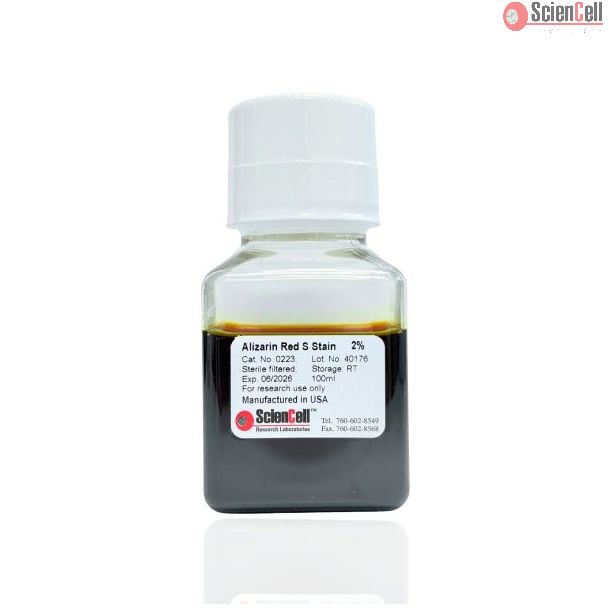
Alizarin Red S Stain
Alizarin Red S Stain is for research use only. Not for use in animals, humans, or diagnostic procedures.
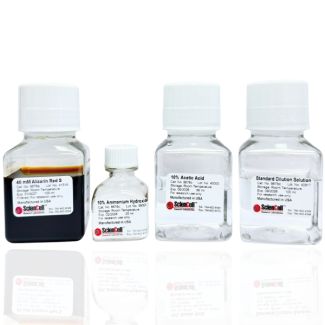
Alizarin Red S is an anthraquinone dye used to stain for calcium deposits, which are indicators of mature osteocytes. The dye forms a complex with calcium during the process of chelation resulting in birefringence. 2% Alizarin Red S Stain (ARed) is a convenient, ready-to-use solution.
Materials Supplied by User (Not provided)
- 4% Paraformaldehyde solution in Phosphate Buffered Saline (PBS)
- Deionized H2O (diH2O)
| Catalog No. | 0223 |
|---|---|
| Country of Manufacture | United States |
| Product Code | ARed |
| Size/Quantity | 100 ml |
| Product use | This product is for research use only. It is not approved for use in humans, animals, or in vitro diagnostic procedures. |
| Storage | Room Temperature |
| Shipping | Room Temperature |
Bioceramic or inorganic nanoparticles made of SiO2, TiO2, SrO, and hydroxyapatite (HAP) have been reported to improve cell adhesion onto polymers. However, direct mixing ... More
Bioceramic or inorganic nanoparticles made of SiO2, TiO2, SrO, and hydroxyapatite (HAP) have been reported to improve cell adhesion onto polymers. However, direct mixing of these nanoparticles with polymers often leads to their aggregation within the polymer matrix and subsequent deterioration of the material’s mechanical strength. A novel method for modifying the surfaces of the nanoparticles by grafting ε-caprolactone using a ring-opening condensation reaction was developed to improve the interconnection of the nanoparticles within the polymer matrix. The mechanical studies showed that adding grafted nanoparticles into the polycaprolactone (PCL) matrix improved the initial mechanical strength. MTT assay and a live/dead stain showed higher cell viability in the tablets with grafted SiO2, TiO2, and HAP nanoparticles, except the SrO-containing tablets. The cell adhesion and alkaline phosphatase activity assay confirmed that the composite tablets with PCL-grafted HAP nanoparticles had better osteoconductivity. HE stains showed that composite tablets with PCL-grafted SiO2, TiO2, and HAP nanoparticles produce less immune response than the pure PCL. We thus conclude that a PCL matrix incorporating PCL-grafted HAP nanoparticles has enhanced mechanical strength, improved osteoconductivity, and a slower degradation rate than pure nanoparticles. Less
ScienCell Research Laboratories (SRL) takes pride in being a resource for researchers all over the world. The publications listed here are not meant as an endorsement or confirmation of the reliability of the products.
Related Products
Check items to add to the cart or