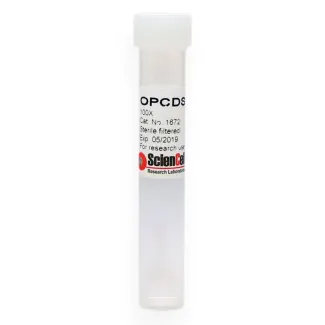
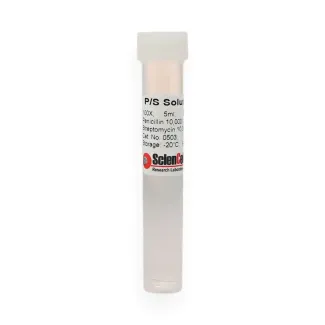
Oligodendrocyte Precursor Cell Differentiation Medium (OPCDM), when used with Oligodendrocyte Precursor Cell Differentiation Supplement (OPCDS, Cat #1672) and 5 ml of fetal bovine serum (FBS) is a complete medium designed for optimal growth of normal oligodendrocyte precursor cells in vitro. It is a sterile, liquid medium which contains essential and non-essential amino acids, vitamins, organic and inorganic compounds, hormones, growth factors, trace minerals and a low concentration of fetal bovine serum (1%). The medium is HEPES and bicarbonate buffered and has a pH of 7.4 when equilibrated in an incubator with an atmosphere of 5% CO2/95% air. The medium is formulated (quantitatively and qualitatively) to provide an optimally balanced nutritional environment that selectively supports the growth of normal oligodendrocyte precursor cells in vitro.
Although transplantation of induced oligodendrocyte progenitor cells (iOPCs) is a promising strategy for white matter injury, the therapeutic efficacy of in vitro-generat... More
Although transplantation of induced oligodendrocyte progenitor cells (iOPCs) is a promising strategy for white matter injury, the therapeutic efficacy of in vitro-generated iOPCs remains limited due to insufficient differentiation potential. Here, we aimed to identify key transcription factors and small-molecule drugs to optimize iOPC quality. Through transcriptome sequencing and bioinformatics analysis, we identified the transcription factor SOX10, which is differentially expressed between endogenous fetal OPCs and exogenous iOPCs. We established lentivirus-mediated SOX10 overexpression in neural stem cells (NSCs) before iOPC induction and performed cellular assays and multi-omics analysis. Early SOX10 overexpression reduced cell migration but promoted maturation into oligodendrocytes and suppressed astrocyte differentiation. Multi-omics analyses revealed that SOX10 overexpression is associated with the extensive redistribution of SOX10 chromatin binding and enrichment of regulatory programs linked to oligodendroglial differentiation, including the activation of the key signaling downstream transcription factors JUN/FOS. Moreover, TSA, Dabrafenib, and Fedratinib effectively upregulated SOX10 and improved iOPC differentiation. This study identifies SOX10 as a core upstream regulator governing the fate of iOPCs, providing a potential strategy for optimizing iOPC induction for future investigation of white matter injury therapy. Less
Cancer is associated with globally hypoacetylated chromatin and considerable attention has recently been focused on epigenetic therapies. N-acetyl-L-aspartate (NAA), the ... More
Cancer is associated with globally hypoacetylated chromatin and considerable attention has recently been focused on epigenetic therapies. N-acetyl-L-aspartate (NAA), the primary storage form of acetate in the brain, and aspartoacylase (ASPA), the enzyme responsible for NAA catalysis to generate acetate and ultimately acetyl-Coenzyme A for histone acetylation, are reduced in oligodendroglioma. The short chain triglyceride glyceryl triacetate (GTA), which increases histone acetylation and inhibits histone deacetylase expression, has been safely used for acetate supplementation in Canavan disease, a leukodystrophy due to ASPA mutation. We demonstrate that GTA induces cytostatic G0 growth arrest of oligodendroglioma-derived cells in vitro, without affecting normal cells. Sodium acetate, at doses comparable to that generated by complete GTA catalysis, but not glycerol also promoted growth arrest, whereas long chain triglycerides promoted cell growth. To begin to elucidate its mechanism of action, the effects of GTA on ASPA and acetyl-CoA synthetase protein levels and differentiation of established human oligodendroglioma cells (HOG and Hs683) and primary tumor-derived oligodendroglioma cells that exhibit some features of cancer stem cells (grade II OG33 and grade III OG35) relative to an oligodendrocyte progenitor line (Oli-Neu) were examined. The nuclear localization of ASPA and acetyl-CoA synthetase-1 in untreated cells was regulated during the cell cycle. GTA-mediated growth arrest was not associated with apoptosis or differentiation, but increased expression of acetylated proteins. Thus, GTA-mediated acetate supplementation may provide a safe, novel epigenetic therapy to reduce the growth of oligodendroglioma cells without affecting normal neural stem or oligodendrocyte progenitor cell proliferation or differentiation. Less
ScienCell Research Laboratories (SRL) takes pride in being a resource for researchers all over the world. The publications listed here are not meant as an endorsement or confirmation of the reliability of the products.

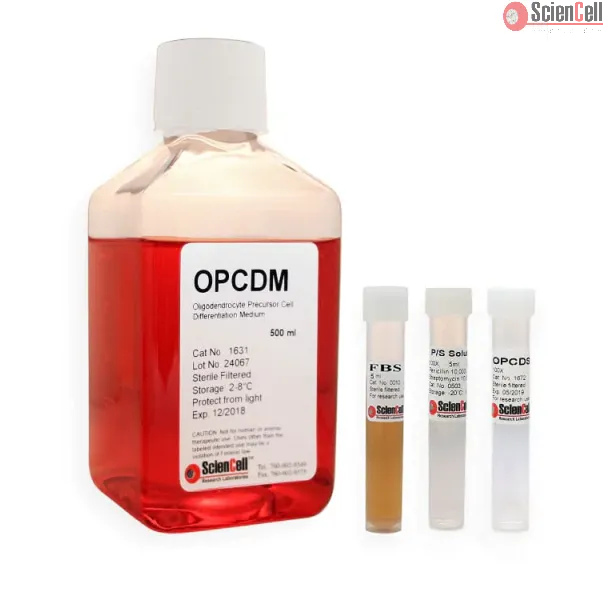
 1631-b-prf (Basal & Phenol Red Free Medium)