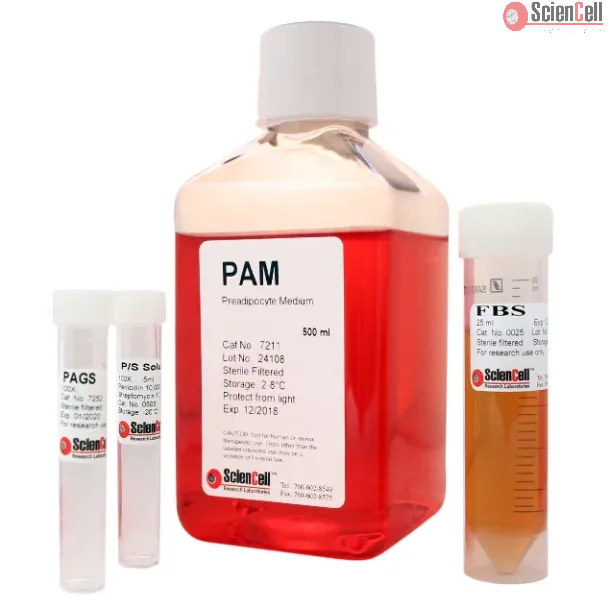
Preadipocyte Medium (PAM), when used with Preadipocyte Growth Supplement (PAGS, Cat #7252) and 25 ml of fetal bovine serum (FBS) is a complete medium designed for optimal growth of normal preadipocytes in vitro. It is a sterile, liquid medium which contains essential and non-essential amino acids, vitamins, organic and inorganic compounds, hormones, growth factors, trace minerals and a low concentration of fetal bovine serum (5%). The medium is HEPES and bicarbonate buffered and has a pH of 7.4 when equilibrated in an incubator with an atmosphere of 5% CO2/95% air. The medium is formulated (quantitatively and qualitatively) to provide an optimally balanced nutritional environment that selectively supports the growth of normal preadipocytes in vitro.
White adipose tissue wasting plays a critical role in the development and progression of cancer cachexia. However, the mechanism behind the loss of adipose tissue remains... More
White adipose tissue wasting plays a critical role in the development and progression of cancer cachexia. However, the mechanism behind the loss of adipose tissue remains ill-defined. In this study, we found that cancer cell-derived exosomes highly expressed miR-425-3p. Administration of cancer cell-derived exosomes significantly inhibited proliferation and differentiation of human preadipocytes-viscereal (HPA-v) cells. In mature adipocytes, cancer cell-derived exosomes activated cAMP/PKA signalling and lipophagy, leading to adipocyte lipolysis and browning of white adipocytes. These exosomes-induced alterations were almost abolished by endocytosis inhibitor cytochalasin D (CytoD) and antagomiR-425-3p, or reproduced by miR-425-3p mimics. In addition, bioinformatics analysis and luciferase reporter assay revealed that miR-425-3p directly targeted proliferation-related genes such as GATA2, IGFBP4, MMP15, differentiation-related gene CEBPA, and phosphodiesterase 4B gene (PDE4B). Depletion of PDE4B enhanced cAMP/PKA signalling and lipophagy, but had no effects on HPA-v proliferation and differentiation. Taken together, these results suggested that cancer cell-derived exosomal miR-425-3p inhibited preadipocyte proliferation and differentiation, increased adipocyte lipolysis, and promoted browning of white adipocytes, all of which might contribute to adipocyte atrophy and ultimately the loss of adipose tissue in cancer cachexia. Less
MicroRNAs (miRNAs) have been identified as a new class of regulatory molecules that influence many biological functions, including metabolism, adipocyte differentiation. ... More
MicroRNAs (miRNAs) have been identified as a new class of regulatory molecules that influence many biological functions, including metabolism, adipocyte differentiation. To determine the role of adipogenic miRNAs in the adipocyte differentiation process, we used microarray technology to monitor miRNA levels in human adipose-derived mesenchymal stem cells (hMSCs-Ad), human stromal vascular cells (SVCs) and differentiated adipocytes. 79 miRNAs were found to be differentially expressed, most of which are located in obesity related chromosomal regions but have not been previously linked to adipocyte differentiation process. A systematic search was made for relevant studies in academic data bases, involving the Gene Expression Omnibus (GEO) ArrayExpress, Pubmed and Embase database. Eight studies on human adipocyte differentiation or obesity were included in the final analysis. After combining our microarray data with meta-analysis of published microarray data, we detected 42 differently expressed miRNAs (meta-signature miRNAs) in mature adipocytes compared to SVCs or hMSCs-Ad. Our study shows meta-signature miRNAs specific for adipogenesis, several of which are correlated with key gene targets demonstrating functional relationships to pathways in BMP signaling pathway, Cell differentiation, Wnt signaling, insulin receptor signaling pathway, MAPK signaling, Cell cycle and lipid metabolic process. Our study shows that the first evidence of hsa-let-7 family, hsa-miR-15a-5p, hsa-miR-27a-3p, hsa-miR-106b-5p, hsa-miR-148a-3p and hsa-miR-26b-5p got a great weight in adipogenesis. We concluded that meta-signature miRNAs involved in adipocyte differentiation and provided pathophysiological roles and novel insight into obesity and its related metabolic diseases. Less
ScienCell Research Laboratories (SRL) takes pride in being a resource for researchers all over the world. The publications listed here are not meant as an endorsement or confirmation of the reliability of the products.

,-25-ml.webp)