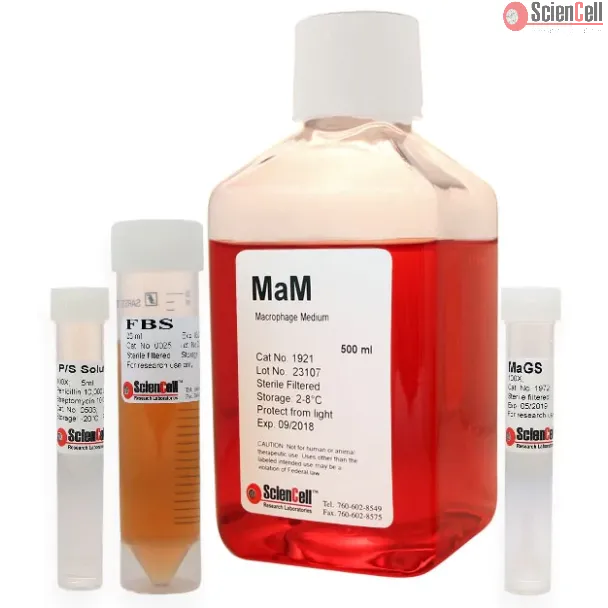
Macrophage Medium (MaM), when used with Macrophage Growth Supplement (MaGS, Cat #1972) and 25 ml of fetal bovine serum (FBS) is a complete medium designed for optimal growth of normal macrophages in vitro. It is a sterile, liquid medium which contains essential and non-essential amino acids, vitamins, organic and inorganic compounds, hormones, growth factors, trace minerals and a low concentration of fetal bovine serum (5%). The medium is HEPES and bicarbonate buffered and has a pH of 7.4 when equilibrated in an incubator with an atmosphere of 5% CO2/95% air. The medium is formulated (quantitatively and qualitatively) to provide an optimally balanced nutritional environment that selectively supports the growth of normal macrophages in vitro.
Aims: Pathological cardiac fibrosis and hypertrophy are common features of left ventricular remodeling that often progress to heart failure (HF). Endothelial cells (ECs) ... More
Aims: Pathological cardiac fibrosis and hypertrophy are common features of left ventricular remodeling that often progress to heart failure (HF). Endothelial cells (ECs) are the most abundant non-myocyte cells in adult mouse heart. Simvastatin, a strong inducer of Krüppel-like Factor 2 (Klf2) in ECs, ameliorates pressure overload induced maladaptive cardiac remodeling and dysfunction. This study aims to explore the detailed molecular mechanisms of the anti-remodeling effects of simvastatin. Methods and Results: RGD-magnetic-nanoparticles were used to endothelial specific delivery of siRNA and we found absence of simvastatin's protective effect on pressure overload induced maladaptive cardiac remodeling and dysfunction after in vivo inhibition of EC-Klf2. Mechanism studies showed that EC-Klf2 inhibition reversed the simvastatin-mediated reduction of fibroblast proliferation and myofibroblast formation, as well as cardiomyocyte size and cardiac hypertrophic genes, which suggested that EC-Klf2 might mediate the anti-fibrotic and anti-hypertrophy effects of simvastatin. Similar effects were observed after Klf2 inhibition in cultured ECs. Moreover, Klf2 regulated its direct target gene TGFβ1 in ECs and mediated the protective effects of simvastatin, and inhibition of EC-Klf2 increased the expression of EC-TGFβ1 leading to simvastatin losing its protective effects. Also, EC-Klf2 was found to regulate EC-Foxp1 and loss of EC-Foxp1 attenuated the protective effects of simvastatin similar to EC-Klf2 inhibition. Conclusions: We conclude that cardiac microvasculature ECs are important in the modulation of pressure overload induced maladaptive cardiac remodeling and dysfunction, and the endothelial Klf2-TGFβ1 or Klf2-Foxp1-TGFβ1 pathway mediates the preventive effects of simvastatin. This study demonstrates a novel mechanism of the non-cholesterol lowering effects of simvastatin for HF prevention. Keywords: Heart failure (HF), Maladaptive cardiac remodeling (cardiac fibrosis and hypertrophy), HMG-CoA reductase inhibitors, Simvastatin, Vascular endothelial cells (ECs), Krüppel-like Factor 2 (Klf2), Transforming growth factor-beta 1 (TGFβ1), Forkhead Box P1 (Foxp1) Less
Myeloperoxidase (MPO), an abundant heme-containing enzyme present in neutrophils, monocytes, and macrophages, is produced in high levels during inflammation, and associat... More
Myeloperoxidase (MPO), an abundant heme-containing enzyme present in neutrophils, monocytes, and macrophages, is produced in high levels during inflammation, and associated with poor reproductive outcomes. MPO is known to generate hypochlorous acid (HOCl), a damaging reactive oxygen species (ROS) utilizing hydrogen peroxide (H2O2) and chloride (Cl-). Here we investigate the effect of activated immune cells and MPO on oocyte quality. Mouse metaphase II oocytes were divided into the following groups: 1) Incubation with a catalytic amount of MPO (40 nM) for different incubation periods in the presence of 100 mM Cl- with and without H2O2 and with and without melatonin (100 μM), at 37°C (n = 648/648 total number of oocytes in each group for oocytes with and without cumulus cells); 2) Co-cultured with activated mouse peritoneal macrophage and neutrophils cells (1.0 x 10⁶ cells/ml) in the absence and presence of melatonin (200 μM), an MPO inhibitor/ROS scavenger, for different incubation periods in HTF media, at 37°C (n = 200/200); 3) Untreated oocytes incubated for 4 hrs as controls (n = 73/64). Oocytes were then fixed, stained and scored based on the microtubule morphology and chromosomal alignment. All treatments were found to negatively affect oocyte quality in a time dependent fashion as compared to controls. In all cases the presence of cumulus cells offered no protection; however significant protection was offered by melatonin. Similar results were obtained with oocytes treated with neutrophils. This work provides a direct link between MPO and decreased oocyte quality. Therefore, strategies to decrease MPO mediated inflammation may influence reproductive outcomes. Less
ScienCell Research Laboratories (SRL) takes pride in being a resource for researchers all over the world. The publications listed here are not meant as an endorsement or confirmation of the reliability of the products.

 1921-b-prf (Basal & Phenol Red Free Medium)
,-25-ml.webp)