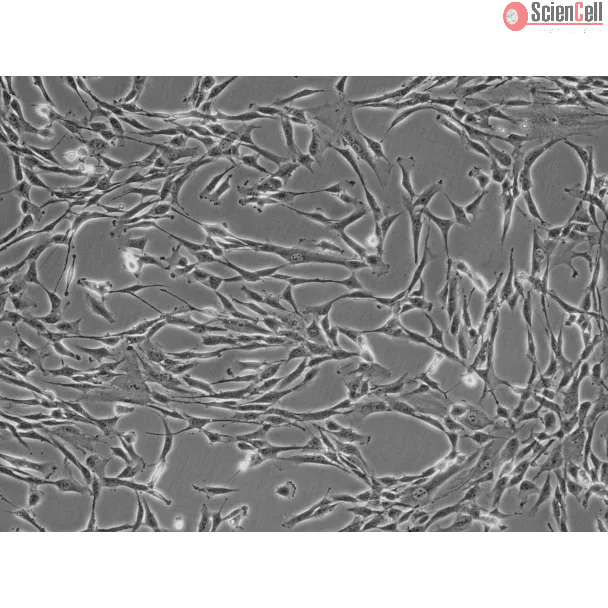
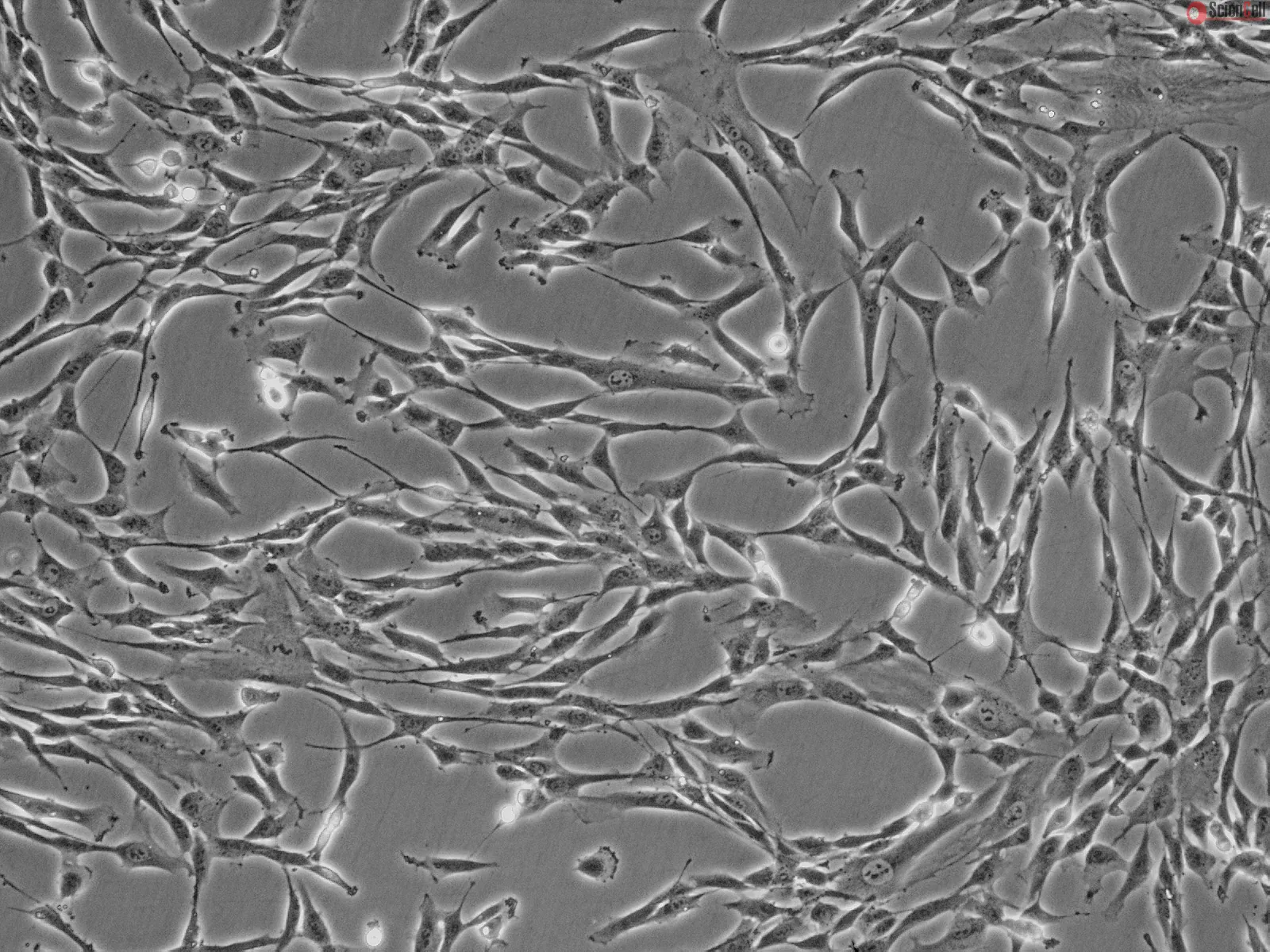
Pancreatic Stellate Cells (HPaSteC) are the main fibroblastic cells of the pancreas. HPaSteC are responsible for the synthesis and the degradation of the extracellular matrix proteins that promote tissue repair. They are found adjacent to pancreatic acinar cells and around small pancreatic ducts and blood vessels. When HPaSteC are activated, they assume myofibroblast-like morphology and secrete excessive amounts of extracellular matrix proteins, which can lead to desmoplasia in chronic pancreatitis and adenocarcinoma. Recent studies have shown that HPaSteC can also act as progenitor cells, immune cells, and intermediaries in exocrine pancreatic secretion. Additionally, HPaSteC stimulate pancreatic cancer proliferation, inhibit apoptosis, and enhance angiogenesis. HPaSteC are the ideal model for studying pancreatic tumor formation and they can be used to develop novel therapies for treatment of chronic pancreatitis and adenocarcinoma.
HPaSteC from ScienCell Research Laboratories are isolated from human pancreas. HPaSteC are cryopreserved at passage one and delivered frozen. Each vial contains >5 x 10⁵ cells in 1 ml volume. HPaSteC are characterized by immunofluorescence with antibodies specific to α-smooth muscle actin. HPaSteC are negative for HIV-1, HBV, HCV, mycoplasma, bacteria, yeast and fungi. HPaSteC are guaranteed to further expand for 15 population doublings under the conditions provided by ScienCell Research Laboratories
Recommended Medium
It is recommended to use Stellate Cell Medium (SteCM, Cat. #5301) for the culturing of HPaSteC in vitro.
Product Sheets
 3830
3830
Search for a Certificate of Analysis by Lot Number below:
Perineural invasion (PNI) is frequent in pancreatic ductal adenocarcinoma (PDAC) and contributes to poor prognosis, yet stromal–neural mechanisms remain unclear. We dev... More
Perineural invasion (PNI) is frequent in pancreatic ductal adenocarcinoma (PDAC) and contributes to poor prognosis, yet stromal–neural mechanisms remain unclear. We developed a vertical multi-co-culture model incorporating human PDAC cells, neonatal mouse dorsal root ganglion (DRG) neurons, and human pancreatic stellate cells (PSCs). Migration assays demonstrated markedly greater PDAC cell migration in DRG + PSC than either condition alone. Proteomic profiling of conditioned media identified Secreted Protein Acidic and Rich in Cysteine (SPARC) as a highly enriched factor in the DRG + PSC condition. Public transcriptomic datasets (TCGA, GTEx, scRNA-seq) confirmed SPARC upregulation in PDAC, with predominant expression in fibroblasts and association with poor survival. Immunohistochemistry of 81 resected PDAC specimens in Hamamatsu University School of Medicine revealed stromal-rich SPARC expression significantly correlated with PNI-positive status. Collectively, these findings indicate that stromal SPARC is associated with PNI-related aggressiveness in PDAC. SPARC may serve as a biomarker of unfavorable prognosis and as a candidate stromal factor warranting future functional validation within the tumor-nerve-stromal axis. Less
Background/Objectives
Chronic pancreatitis (CP) is a pathological syndrome of the pancreas characterized by fibrosis and inflammation. At present, there is no definitive ... More
Background/Objectives
Chronic pancreatitis (CP) is a pathological syndrome of the pancreas characterized by fibrosis and inflammation. At present, there is no definitive cure for CP. Sodium–glucose cotransporter-2 (SGLT2) inhibitors, a class of antidiabetic drugs, have been reported to exert antifibrotic effects in several organs. We evaluated the antifibrotic effect of the SGLT2 inhibitor canagliflozin on the pancreas.
Methods
C57BL/6 mice carrying a Kras mutation were intraperitoneally injected with caerulein to induce CP. Pancreatic tissues were collected after 8 weeks of feeding with or without canagliflozin and subsequently evaluated. The antifibrotic effects were also assessed in human pancreatic stellate cells (HPSCs) and in pancreatic tissue from patients with CP.
Results
Canagliflozin preserved pancreatic acinar cells and insulin–positive cells, and reduced pancreatic fibrosis in vivo. In HPSCs, canagliflozin suppressed proliferation, migration, and the expression of fibrotic markers and connective tissue growth factor (CTGF), unlike other SGLT2 inhibitors. A cytokine array was used to investigate the antifibrotic mechanism. Canagliflozin significantly downregulated osteoprotegerin (OPG), leading to the suppression of fibrotic markers and CTGF. Furthermore, canagliflozin activated AMP-activated protein kinase (AMPK), which contributed to the downregulation of OPG. This effect was also observed in pancreatic tissue in vivo by Western blot analysis. In addition, pancreatic tissue from patients with CP contained significantly more OPG-positive cells than did control pancreatic tissue. These results indicate that canagliflozin suppressed pancreatic fibrosis by downregulating OPG.
Conclusion
Canagliflozin may be an effective therapeutic agent for CP, and our data suggest the AMPK–OPG–CTGF axis is a novel target in CP. Less
Extracellular matrix (ECM) remodelling is integral to numerous physiological and pathological processes in biology, such as embryogenesis, wound healing, fibrosis and can... More
Extracellular matrix (ECM) remodelling is integral to numerous physiological and pathological processes in biology, such as embryogenesis, wound healing, fibrosis and cancer. Until recently, most cellular studies have been conducted on 2D environments where mechanical cues significantly differ from physiologically relevant 3D environments, impacting cellular behaviour and masking the interpretation of cellular function in health and disease. We present an integrated methodology where cell-ECM interactions can be investigated in 3D environments via ECM remodelling. Monitoring and quantification of collagen-I structure in remodelled matrices, through designated algorithms, show that 3D matrices can be used to correlate remodelling with increased ECM stiffness observed in fibrosis. Pancreatic stellate cells (PSCs) are the key effectors of the stromal fibrosis associated to pancreatic cancer. We use PSCs to implement our methodology and demonstrate that PSC matrix remodelling capabilities depend on their contractile machinery and β1 integrin-mediated cell-ECM attachment. KEY WORDS: 3D Biology, ECM remodelling, SHG, AFM Less
The mammalian diffuse stellate cell system comprises retinoid-storing cells capable of remarkable transformations from a quiescent to an activated myofibroblast-like phen... More
The mammalian diffuse stellate cell system comprises retinoid-storing cells capable of remarkable transformations from a quiescent to an activated myofibroblast-like phenotype. Activated pancreatic stellate cells (PSCs) attract attention owing to the pivotal role they play in development of tissue fibrosis in chronic pancreatitis and pancreatic cancer. However, little is known about the actual role of PSCs in the normal pancreas. These enigmatic cells have recently been shown to respond to phy... Less
ScienCell Research Laboratories (SRL) takes pride in being a resource for researchers all over the world. The publications listed here are not meant as an endorsement or confirmation of the reliability of the products.






,-1-mg-ml--2.jpg)