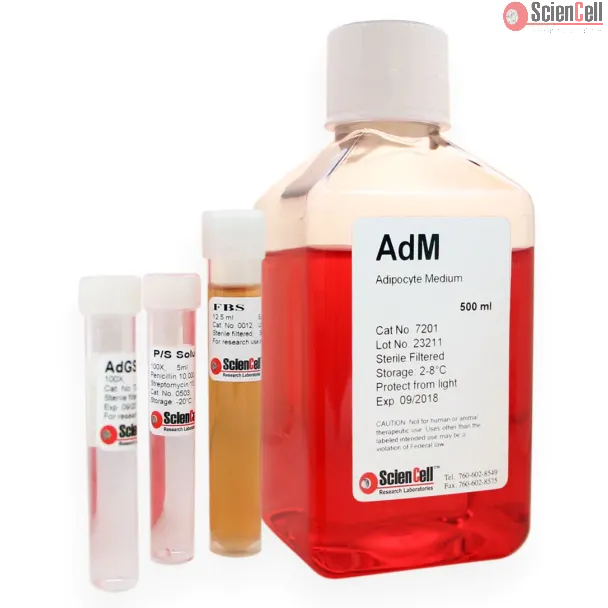
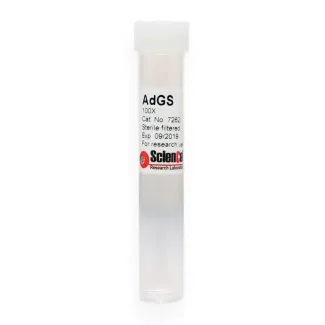
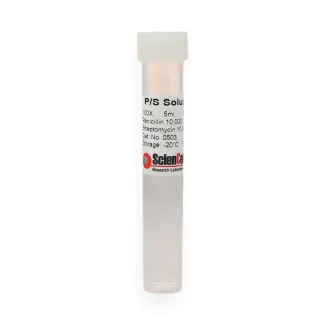
Adipocyte Medium (AdM), when used with Adipocyte Growth Supplement (AdGS, Cat #7262) and 12.5 ml of fetal bovine serum (FBS) is a complete medium designed for optimal growth of normal adipocytes in vitro. It is a sterile, liquid medium which contains essential and non-essential amino acids, vitamins, organic and inorganic compounds, hormones, growth factors, trace minerals and a low concentration of fetal bovine serum (2.5%). The medium is HEPES and bicarbonate buffered and has a pH of 7.4 when equilibrated in an incubator with an atmosphere of 5% CO2/95% air. The medium is formulated (quantitatively and qualitatively) to provide an optimally balanced nutritional environment that selectively supports the growth of normal adipocytes in vitro.
Objective: Due to high levels of serum gonadotropin-releasing hormone (GnRH), perimenopausal or menopausal women, girls with central precocious puberty, women of polycyst... More
Objective: Due to high levels of serum gonadotropin-releasing hormone (GnRH), perimenopausal or menopausal women, girls with central precocious puberty, women of polycystic ovary syndrome, and females receiving long-term GnRH agonist (GnRHa) treatment are at substantially higher risk of developing obesity. However, it remains poorly understood how GnRH affects body weight. Here, we explored whether the gonadotropin-releasing hormone receptor (GnRHR) was expressed in adipocytes and how GnRHR mediated lipid accumulation and the development of obesity. Methods: The samples were from 18 patients with benign tumors operated between 01/2018 and 06/2018 at the Women's Hospital School of Medicine Zhejiang University. Immunofluorescence, Western Blotting, and RT-PCR were used to detect whether the GnRH receptor was expressed in the specimens and human preadipocytes-subcutaneous (HPA-s). The GnRH receptor agonist diphereline with different concentrations was used to stimulate the HPA-s cells for 24, 48, and CCK-8 was used to detect cell proliferation. Oil red-O staining was used to detect lipid droplets in mature adipocytes. The phosphorylation of AMPK-Ser485/Thr172 was detected by Western Blotting. Results: GnRH receptor was expressed in all 18 human subcutaneous adipose tissue specimens. Cultured HPA-s expressed the GnRH receptor, and the expression increased during the process of cell maturation. The GnRH receptor agonist diphereline can stimulate the proliferation of HPA-s cells, which can advance the earliest occurrence of lipid droplets in HPA-s cells and the occurrence of lipid droplets in 50% cells by 1-2 days. Diphereline can stimulate the increase in the number of lipid droplets in mature adipocytes. The phosphorylation level of AMPK-Ser485/Thr172 in mature adipocytes was decreased by diphereline. Conclusion: The GnRH receptor was expressed in adipocytes. As adipocytes mature, GnRH receptor expression gradually increased. GnRHa stimulates the proliferation of HPA-s, promotes adipocyte maturation, increases the formation of lipid droplets in mature adipocytes, and inhibits the activation of the AMPK pathway in adipocytes. Our findings may elucidate the mechanism of obesity in these female populations and provide some evidence on how GnRH contributes to obesity. Additionally, these results provide theoretical support for further research on the mechanisms of obesity, thus enhancing our understanding of the functional diversity of GnRH and establishing a new theoretical basis for the impact of GnRH on metabolism. Keywords: Gonadotropin-releasing hormone, gonadotropin-releasing hormone receptor, adipocytes, AMP-activated protein kinases, obesity, women Less
Thyroid associated ophthalmopathy (TAO) is an organ-specific autoimmune disease occurring in patients with thyroid disease. Patients with TAO-related proptosis is largely... More
Thyroid associated ophthalmopathy (TAO) is an organ-specific autoimmune disease occurring in patients with thyroid disease. Patients with TAO-related proptosis is largely due to excessive orbital adipose tissue Adipocyte phospholipase A2 (AdPLA) is one of the most important regulatory factors in adipocyte lipolysis, which may be associated with TAO-related proptosis. Thus, silencing AdPLA by RNA interference may be beneficial for the treatment of TAO. In this study, we sought to evaluate the efficiency of two types of microneedles to deliver siRNAs for silencing AdPLA. Our results showed that AdPLA mRNA was up-regulated in the orbit adipose tissues from TAO patients. Silence of AdPLA by siRNA can reduce lipid accumulation in both human and mouse adipocyte cell lines. Moreover, silence effects of silicon microneedle array patch-based and injectable microneedle device-based siRNA administration were examined at the belly site of the mice, and injectable microneedle device showed higher knockdown efficiency than silicon microneedle array patch. This study sets the stage not only for future treatment of TAO-related proptosis using AdPLA siRNA, but also provides the foundation for targeted siRNA delivery by using microneedles. Less
Objective The production of uric acid in murine white adipose tissue (mWAT), and that such production was augmented in obese mice, was recently reported. However, little ... More
Objective The production of uric acid in murine white adipose tissue (mWAT), and that such production was augmented in obese mice, was recently reported. However, little is known about the secretion of metabolites associated with purine catabolism in human WAT (hWAT). The present study analyzed this in hWAT. Methods Freshly isolated hWAT and mWAT were cultured. The secretion of metabolites associated with purine catabolism was measured. Tissue distribution profiles of genes associated with purine metabolism and metabolite profiling of adipocytes in hypoxia were analyzed. Results Secretion of hypoxanthine from hWAT was higher than those of xanthine and uric acid. On the other hand, secretion of uric acid was relatively higher than xanthine and hypoxanthine in mWAT. Xanthine oxidoreductase (XOR) mRNA expression levels in hWAT were markedly lower than that in the human liver. In murine tissues, XOR mRNA expression levels in mWAT were comparable with those in the liver. Cultured human adipocytes secreted hypoxanthine, and its secretion was increased under hypoxia. The metabolic analysis of human adipocytes showed that hypoxia increased metabolites associated with de novo biosynthesis of purine nucleotides. Conclusions The present study revealed that hypoxanthine was secreted from human adipose tissue, and the secretion might be increased in local hypoxia. Less
ScienCell Research Laboratories (SRL) takes pride in being a resource for researchers all over the world. The publications listed here are not meant as an endorsement or confirmation of the reliability of the products.