
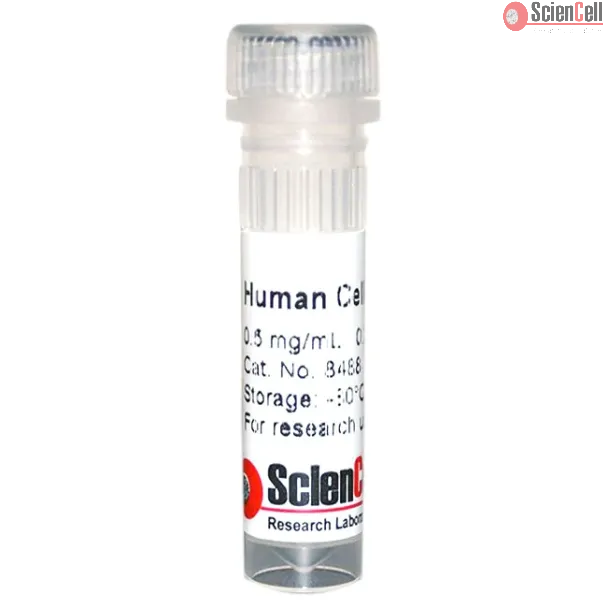
Human Cellular Fibronectin
ScienCellTM Human Cellular Fibronectin (HCF) is produced from human fibroblasts maintained in serum-free media and then purified biochemically. This is supplied sterile in CAPS saline buffer.
Caution: If handled improperly, some components of this product may present a health hazard. Take appropriate precautions when handling this product, including the wearing of protective clothing and eyewear. Dispose of properly.
Fibronectin is a multi-domain glycoprotein composed of an array of multiple repeated modular structures. Cellular fibronectin, an adhesion glycoprotein of the extracellular matrix, exists as a dimer with a molecular mass of ~ 550 kDa. This structure is composed of two heterodimers, the A chain and the B chain containing the type III connecting segment region. Cellular fibronectin differs from plasma fibronectin by the presence of additional polypeptide segments and its capacity to specifically regulate morphology and growth of attached cells including stem cells [1, 2, 3, 4]. Multiple domains of fibronectin show binding affinities for collagen, fibrin, heparin, and specific cell membrane receptors such as integrins. Fibronectin matrix assembly is essential for normal development and contributes to the generation of tumor metastases.
ScienCellTM Human Cellular Fibronectin (HCF) is produced from human fibroblasts maintained in serum-free media and then purified biochemically. HCF is supplied sterile in CAPS saline buffer.
Product Specification
Quantity: 0.1 mg
Concentration: 0.5 mg/ml
Storage buffer: CAPS saline buffer, pH 11.
| Catalog No. | 8488 |
|---|---|
| Country of Manufacture | United States |
| Product Code | HCF |
| Size/Quantity | 0.1 mg |
| Product use | This product is for research use only. It is not approved for use in humans, animals, or in vitro diagnostic procedures. |
| Storage | It is recommended to store the product as single use aliquots at -80°C. Thawing should be done slowly at 2-8°C with no agitation. Material that fails to dissolve can be removed by centrifugation. Avoid repeating freeze/thaw cycles. |
| Shipping | Dry ice. |
Product Sheets

Search for a Certificate of Analysis by Lot Number below:
Find answers to common questions about ScienCell products, cell culture, handling, and research applications.
ScienCell Research Laboratories (SRL) takes pride in being a resource for researchers all over the world. The publications listed here are not meant as an endorsement or confirmation of the reliability of the products.