Host-pathogen interactions can induce epigenetic changes in the host directly, as well as indirectly through secreted factors. Previously, uropathogenic Escherichia coli ... More
Host-pathogen interactions can induce epigenetic changes in the host directly, as well as indirectly through secreted factors. Previously, uropathogenic Escherichia coli (UPEC) was shown to increase DNA methyltransferase activity and expression, which was associated with methylation-dependent alterations in the urothelial expression of CDKN2A. Here, we showed that paracrine factors from infected cells alter expression of another epigenetic writer, EZH2, coordinate with proliferation. Urothelia... Less
High-grade (HG) bladder cancers (BCs) are genetically unstable and have an unpredictable course. The identification of prognostic factors in HG non-muscle invasive BC (NM... More
High-grade (HG) bladder cancers (BCs) are genetically unstable and have an unpredictable course. The identification of prognostic factors in HG non-muscle invasive BC (NMIBC) is crucial for improving patients’ quality of life and preventing BC-specific mortality. Here, we used an antibody microarray (AbM) to identify novel candidate biomarkers in primary HG NMIBC and validated the prognostic significance of the candidate biomarkers. Three pairs of tissue samples from primary HG NMIBC and normal urothelium were analyzed using an AbM kit containing 656 antibodies, and differentially expressed proteins were identified. Among the 42 upregulated and 14 downregulated proteins with statistical significance in BC tissues, CREB-binding protein and CD81 were selected as representative upregulated and downregulated candidate biomarkers, respectively. We then validated the expression of these candidate biomarkers in primary human urothelial cells and BC cell lines by western blotting and immunofluorescence assays, and the results were consistent with the AbM expression profiles. Additionally, Kaplan-Meier survival using immunohistochemical data from an independent primary HG NMIBC cohort comprising 113 patients showed that expression of the 2 biomarkers was significantly associated with recurrence-free and progression-free survival. In multivariate analysis, the 2 biomarkers remained significant predictors for recurrence-free survival. Taken together, our findings suggest that expression of CREB-binding protein and CD81 in BC tissue specimens may have prognostic value in patients with primary HG NMIBC. Less
In this study, we report that EMP2 plays a tumor suppressor role by inducing
Autophagy, a type II programmed cell death, is essential for cell survival under stress, e.g. lung injury, and bone marrow-derived mesenchymal stem cells (BM-MSCs) have g... More
Autophagy, a type II programmed cell death, is essential for cell survival under stress, e.g. lung injury, and bone marrow-derived mesenchymal stem cells (BM-MSCs) have great potential for cell therapy. However, the mechanisms underlying the BM-MSC activation of autophagy to provide a therapeutic effect in ischaemia/reperfusion-induced lung injury (IRI) remain unclear. Thus, we investigate the activation of autophagy in IRI following transplantation with BM-MSCs. Seventy mice were pre-treated with BM-MSCs before they underwent lung IRI surgery in vivo. Human pulmonary micro-vascular endothelial cells (HPMVECs) were pre-conditioned with BM-MSCs by oxygen-glucose deprivation/reoxygenation (OGD) in vitro. Expression markers for autophagy and the phosphoinositide 3-kinase/protein kinase B (PI3K/Akt) signalling pathway were analysed. In IRI-treated mice, administration of BM-MSCs significantly attenuated lung injury and inflammation, and increased the level of autophagy. In OGD-treated HPMVECs, co-culture with BM-MSCs attenuated endothelial permeability by decreasing the level of cell death and enhanced autophagic activation. Moreover, administration of BM-MSCs decreased the level of PI3K class I and p-Akt while the expression of PI3K class III was increased. Finally, BM-MSCs-induced autophagic activity was prevented using the inhibitor LY294002. Administration of BM-MSCs attenuated lung injury by improving the autophagy level via the PI3K/Akt signalling pathway. These findings provide further understanding of the mechanisms related to BM-MSCs and will help to develop new cell-based therapeutic strategies in lung injury. Less
Reconstruction of the bladder by means of both natural and synthetic materials remains a challenge due to severe adverse effects such as mechanical failure. Here we inves... More
Reconstruction of the bladder by means of both natural and synthetic materials remains a challenge due to severe adverse effects such as mechanical failure. Here we investigate the application of spider major ampullate gland-derived dragline silk from the Nephila edulis spider, a natural biomaterial with outstanding mechanical properties and a slow degradation rate, as a potential scaffold for bladder reconstruction by studying the cellular response of primary bladder cells to this biomaterial. We demonstrate that spider silk without any additional biological coating supports adhesion and growth of primary human urothelial cells (HUCs), which are multipotent bladder cells able to differentiate into the various epithelial layers of the bladder. HUCs cultured on spider silk did not show significant changes in the expression of various epithelial-to-mesenchymal transition and fibrosis associated genes, and demonstrated only slight reduction in the expression of adhesion and cellular differentiation genes. Furthermore, flow cytometric analysis showed that most of the silk-exposed HUCs maintain an undifferentiated immunophenotype. These results demonstrate that spider silk from the Nephila edulis spider supports adhesion, survival and growth of HUCs without significantly altering their cellular properties making this type of material a suitable candidate for being tested in pre-clinical models for bladder reconstruction. Less
BK polyomavirus (BKPyV)-associated hemorrhagic cystitis (PyVHC) complicates 5 to 15% of allogeneic hematopoietic stem cell transplantations. Targeted antivirals are still... More
BK polyomavirus (BKPyV)-associated hemorrhagic cystitis (PyVHC) complicates 5 to 15% of allogeneic hematopoietic stem cell transplantations. Targeted antivirals are still unavailable. Brincidofovir (BCV; previously CMX001) has shown inhibitory activity against diverse viruses, including BKPyV in a primary human renal tubule cell culture model of polyomavirus-associated nephropathy. We investigated the effects of BCV in BKPyV-infected and uninfected primary human urothelial cells (HUCs), the target cells of BKPyV in PyVHC. The BCV concentrations causing 50 and 90% reductions (EC50 and EC90) in the number of intracellular BKPyV genome equivalents per cell (icBKPyV) were 0.27 μM and 0.59 μM, respectively. At 0.63 μM, BCV reduced viral late gene expression by 90% and halted progeny release. Preinfection treatment for only 24 h reduced icBKPyV similarly to treatment from 2 to 72 h postinfection, while combined pre- and postinfection treatment suppressed icBKPyV completely. After investigating BCV's effects on HUC viability, mean selectivity indices at 50 and 90% inhibition (SI50 and SI90) calculated for cellular DNA replication were 2.7 and 2.9, respectively, those for mitochondrial activity were 8.9 and 10.4, those for total ATP were 8.6 and 8.2, and those for membrane integrity were 25.9 and 16.7. The antiviral and cytostatic effects, but less so the cytotoxic effects, were inversely related to cell density. The cytotoxic effects at concentrations of ≥10 μM were rapid and likely related to BCV's lipid moiety. After carefully defining the antiviral, cytostatic, and cytotoxic properties of BCV in HUCs, we conclude that a preemptive or prophylactic approach in PyVHC is likely to give the best results. Less
Background: The high risk of recurrence faced by patients with bladder cancer has necessitated the administration of supplemental intravesical chemotherapy; however, such... More
Background: The high risk of recurrence faced by patients with bladder cancer has necessitated the administration of supplemental intravesical chemotherapy; however, such treatments often result in severe side effects. As a result, novel intravesical agents with enhanced efficacy and minimal toxicity are urgently required for the treatment of bladder cancer. Methods: Guizhi Fuling Wan (GFW) is a traditional Chinese medicine shown to inhibit the growth of hepatocellular carcinoma. This study evaluated the growth inhibition of GFW using normal human urothelial cells and bladder cancer cells; the efficacy of GFW treatment was further compared with mitomycin C, epirubicin, and cisplatin. We also examined the progression of cell cycle and apoptosis in bladder cancer cells in response to GFW treatment. CCK-8 was employed to analyze cell viability and flow cytometry was used to study the cell cycle and apoptosis. The mechanisms underlying GFW-induced cell cycle arrest were determined by Western blot analysis. Results: Our data demonstrate the potent inhibitory effect of GFW in the proliferation of bladder cancer cell lines, BFTC 905 and TSGH 8301. GFW presented relatively high selectivity with regard to cancer cells and minimal toxicity to normal urothelial cells. Our results also demonstrate that GFW interferes with cell cycle progression through the activation of CHK2 and P21 and induces apoptosis in these bladder cancer cells. Conclusions: Our results provide experimental evidence to support GFW as a strong candidate for intravesicle chemotherapy against bladder cancer. Less

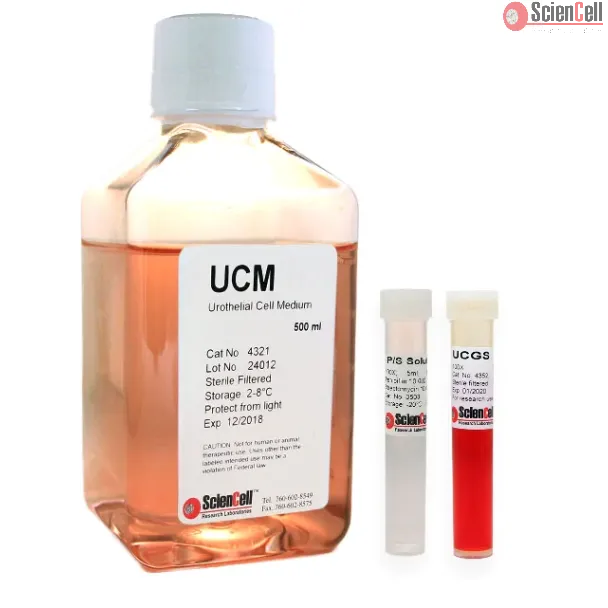
 4321-b-prf (Basal & Phenol Red Free Medium)