Objectives Interleukin 18 (IL-18) is a regulatory cytokine that degrades the disc matrix. Bone morphogenetic protein-2 (BMP-2) stimulates synthesis of the disc extracellu... More
Objectives Interleukin 18 (IL-18) is a regulatory cytokine that degrades the disc matrix. Bone morphogenetic protein-2 (BMP-2) stimulates synthesis of the disc extracellular matrix. However, the combined effects of BMP-2 and IL-18 on human intervertebral disc degeneration have not previously been reported. The aim of this study was to investigate the effects of the anabolic cytokine BMP-2 and the catabolic cytokine IL-18 on human nucleus pulposus (NP) and annulus fibrosus (AF) cells and, therefore, to identify potential therapeutic and clinical benefits of recombinant human (rh)BMP-2 in intervertebral disc degeneration. Methods Levels of IL-18 were measured in the blood of patients with intervertebral disc degenerative disease and in control patients. Human NP and AF cells were cultured in a NP cell medium and treated with IL-18 or IL-18 plus BMP-2. mRNA levels of target genes were measured by real-time polymerase chain reaction, and protein levels of aggrecan, type II collagen, SOX6, and matrix metalloproteinase 13 (MMP13) were assessed by western blot analysis. Results The serum level of patients (IL-18) increased significantly with the grade of IVD degeneration. There was a dramatic alteration in IL-18 level between the advanced degeneration (Grade III to V) group and the normal group (p = 0.008) Furthermore, IL-18 induced upregulation of the catabolic regulator MMP13 and downregulation of the anabolic regulators aggrecan, type II collagen, and SOX6 at 24 hours, contributing to degradation of disc matrix enzymes. However, BMP-2 antagonised the IL-18 induced upregulation of aggrecan, type II collagen, and SOX6, resulting in reversal of IL-18 mediated disc degeneration. Conclusions BMP-2 is anti-catabolic in human NP and AF cells, and its effects are partially mediated through provocation of the catabolic effect of IL-18. These findings indicate that BMP-2 may be a unique therapeutic option for prevention and reversal of disc degeneration. Cite this article: S. Ye, B. Ju, H. Wang, K-B. Lee. Bone morphogenetic protein-2 provokes interleukin-18-induced human intervertebral disc degeneration. Bone Joint Res 2016;5:412–418. DOI: 10.1302/2046-3758.59.BJR-2016-0032.R1. Keywords: Bone morphogenetic protein-2 (BMP-2), Interleukin-18 (IL-18), Nucleus pulposus and annulus fibrosus cells, Intervertebral disc degeneration (IVD) Less
Inflammation and cytokines have been recognized to correlate with intervertebral disc (IVD) degeneration (IDD), via mediating the development of clinical signs and sympto... More
Inflammation and cytokines have been recognized to correlate with intervertebral disc (IVD) degeneration (IDD), via mediating the development of clinical signs and symptoms. However, the regulation mechanism remains unclear. We aimed at investigating the regulatory role of interleukin (IL)β and high mobility group box 1 (HMGB1) in the inflammatory response in human IVD cells, and then explored the signalling pathways mediating such regulatory effect. Firstly, the promotion to inflammatory cytokines in IVD cells was examined with ELISA method. And then western blot and real time quantitative PCR were performed to analyse the expression of toll-like receptors (TLRs), receptors for advanced glycation endproducts (RAGE) and NF-κB signalling markers in the IL-1β- or (and) HMGB1-treated IVD cells. Results demonstrated that either IL-1β or HMGB1 promoted the release of the inflammatory cytokines such as prostaglandin E2 (PGE2), TNF-α, IL-6 and IL-8 in human IVD cells. And the expression of matrix metalloproteinases (MMPs) such as MMP-1, -3 and -9 was also additively up-regulated by IL-1β and HMGB1. We also found such additive promotion to the expression of TLR-2, TLR-4 and RAGE, and the NF-κB signalling in intervertebral disc cells. In summary, our study demonstrated that IL-1β and HMGB1 additively promotes the release of inflammatory cytokines and the expression of MMPs in human IVD cells. The TLRs and RAGE and the NF-κB signalling were also additively promoted by IL-1β and HMGB1. Our study implied that the additive promotion by IL-1β and HMGB1 to inflammatory cytokines and MMPs might aggravate the progression of IDD. Keywords: high mobility group box 1 (HMGB1); interleukin (IL)β; intervertebral disc degeneration (IDD). © 2016 The Author(s). Less
Autophagy, a type II programmed cell death, is essential for cell survival under stress, e.g. lung injury, and bone marrow-derived mesenchymal stem cells (BM-MSCs) have g... More
Autophagy, a type II programmed cell death, is essential for cell survival under stress, e.g. lung injury, and bone marrow-derived mesenchymal stem cells (BM-MSCs) have great potential for cell therapy. However, the mechanisms underlying the BM-MSC activation of autophagy to provide a therapeutic effect in ischaemia/reperfusion-induced lung injury (IRI) remain unclear. Thus, we investigate the activation of autophagy in IRI following transplantation with BM-MSCs. Seventy mice were pre-treated with BM-MSCs before they underwent lung IRI surgery in vivo. Human pulmonary micro-vascular endothelial cells (HPMVECs) were pre-conditioned with BM-MSCs by oxygen-glucose deprivation/reoxygenation (OGD) in vitro. Expression markers for autophagy and the phosphoinositide 3-kinase/protein kinase B (PI3K/Akt) signalling pathway were analysed. In IRI-treated mice, administration of BM-MSCs significantly attenuated lung injury and inflammation, and increased the level of autophagy. In OGD-treated HPMVECs, co-culture with BM-MSCs attenuated endothelial permeability by decreasing the level of cell death and enhanced autophagic activation. Moreover, administration of BM-MSCs decreased the level of PI3K class I and p-Akt while the expression of PI3K class III was increased. Finally, BM-MSCs-induced autophagic activity was prevented using the inhibitor LY294002. Administration of BM-MSCs attenuated lung injury by improving the autophagy level via the PI3K/Akt signalling pathway. These findings provide further understanding of the mechanisms related to BM-MSCs and will help to develop new cell-based therapeutic strategies in lung injury. Less
Previous studies have demonstrated that the expression levels of cytokines are increased in degenerated intervertebral disc tissues, and several cytokines are associated ... More
Previous studies have demonstrated that the expression levels of cytokines are increased in degenerated intervertebral disc tissues, and several cytokines are associated with the pathogenesis of intervertebral disc degeneration. However, the role of interleukin (IL)‑2 in the cellular functions of intervertebral disc tissues remains unreported. The present study aimed to determine the expression levels of IL‑2 in the nucleus pulposus (NP) tissues of patients with a prolapsed lumbar intervertebral disc; and to observe the changes in cell proliferation, apoptosis, extracellular matrix (ECM) metabolism and p38 mitogen‑activated protein kinase (MAPK) signaling in human NP cells (HNPCs) following treatment with IL‑2. The present study demonstrated that IL‑2 expression levels were upregulated in the NP tissues of patients with a prolapsed lumbar intervertebral disc; and a subsequent MTT assay demonstrated that IL‑2 inhibits the proliferation of HNPCs in a dose‑dependent manner. Furthermore, as demonstrated by the increased protein expression levels of Fas cell surface death receptor and the induction of caspase‑8 and caspase‑3 activity, the death receptor pathway was activated by IL‑2 in the HNPCs in order to promote cell apoptosis. In addition, IL‑2 promoted ECM degradation in the HNPCs, as demonstrated by an increase in the expression levels of type I collagen, a disintegrin and metalloproteinase with thrombospondin motifs and matrix metalloproteinases, and decreased aggrecan and type II collagen expression levels. Furthermore, phosphorylated‑p38 was significantly increased in the HNPCs following IL‑2 treatment. In conclusion, the present study demonstrated that IL‑2 inhibits cell proliferation, and induces cell apoptosis and ECM degradation, accompanied by the activation of p38 MAPK signaling in HNPCs. Therefore, IL-2 may be a potential therapeutic agent for the treatment of degenerative disc disease. Less

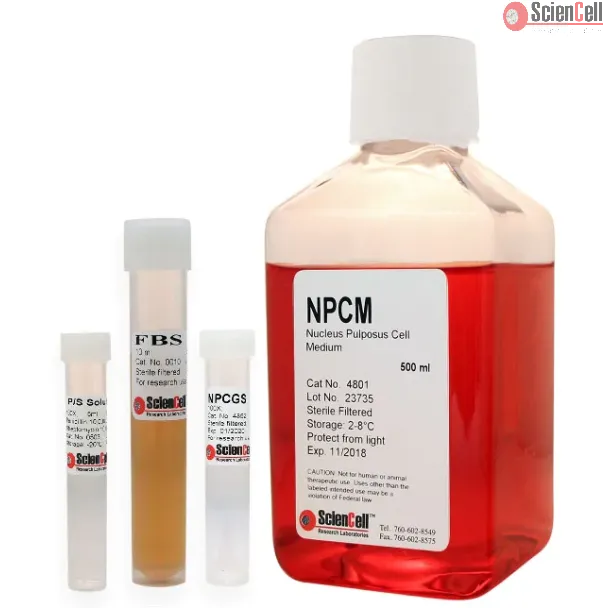
 4801-b-prf (Basal & Phenol Red Free Medium)