
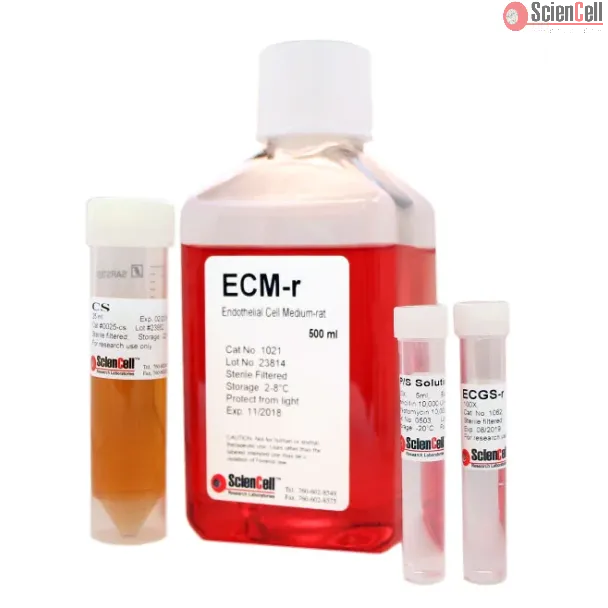
Endothelial Cell Medium-rat
Endothelial Cell Medium-rat (ECM-r) consists of 500 ml of basal medium, 25 ml of CS (Cat. #0025-cs), 5 ml of Endothelial Cell Growth Supplement-rat (ECGS-r, Cat. #1062) and 5 ml of penicillin/streptomycin solution (P/S, Cat. #0503).
Endothelial Cell Medium-rat (ECM-r), when used with Endothelial Cell Growth Supplement-rat (ECGS-r, Cat #1062) and 25 ml of calf serum (CS, Cat #0025-cs) is a complete medium designed for optimal growth of normal rat endothelial cells in vitro. It is a sterile, liquid medium which contains essential and non-essential amino acids, vitamins, organic and inorganic compounds, hormones, growth factors, trace minerals and a low concentration of calf serum (5%). The medium is HEPES and bicarbonate buffered and has a pH of 7.4 when equilibrated in an incubator with an atmosphere of 5% CO2/95% air. The medium is formulated (quantitatively and qualitatively) to provide an optimally balanced nutritional environment that selectively supports the growth of normal rat endothelial cells in vitro.
| Catalog No. | 1021 |
|---|---|
| Country of Manufacture | United States |
| Product Code | ECM-r |
| Size/Quantity | 500 ml |
| Product use | This product is for research use only. It is not approved for use in humans, animals, or in vitro diagnostic procedures. |
| Storage | Store the basal medium at 4°C, the ECGS-r, the FBS and the P/S solution at -20°C. Protect from light. |
| Shipping | Basal medium: room temperature. Supplements: dry ice. |
Product Sheets
 1021-b-prf (Basal & Phenol Red Free Medium)
1021-prf (Complete Phenol Red Free Medium)
Search for a Certificate of Analysis by Lot Number below:
Find answers to common questions about ScienCell products, cell culture, handling, and research applications.
Write Your Own Review
Traumatic brain injury (TBI) is a major cause of morbidity and mortality worldwide, affecting over 10 million people annually, with an estimated cost of $76.5 billion. Al... More
ScienCell Research Laboratories (SRL) takes pride in being a resource for researchers all over the world. The publications listed here are not meant as an endorsement or confirmation of the reliability of the products.
Related Products
Check items to add to the cart or
,-25-ml.webp)