成纤维细胞是来源于胚胎中胚层的间充质细胞。由于其是最容易在体外培养的细胞类型之一,广泛用于各种细胞和分子研究。它们的耐受性也使其适用于多种实验操作,包括基因转染和显微注射等研究。有研究表明,不同器官中的成纤维细胞在本质上存在差异。组织内的成纤维细胞暴露于动态的机械环境中,这种环境会影响健康和修复性软组织的结构完整性。成纤维细胞分泌一种富含 I 型和/或 III 型胶原蛋白的非刚性细胞外基质。培养的前列腺成纤维细胞会合成类 FGF 生长因子来促进自身生长,这可能与良性前列腺增生的发生有关。
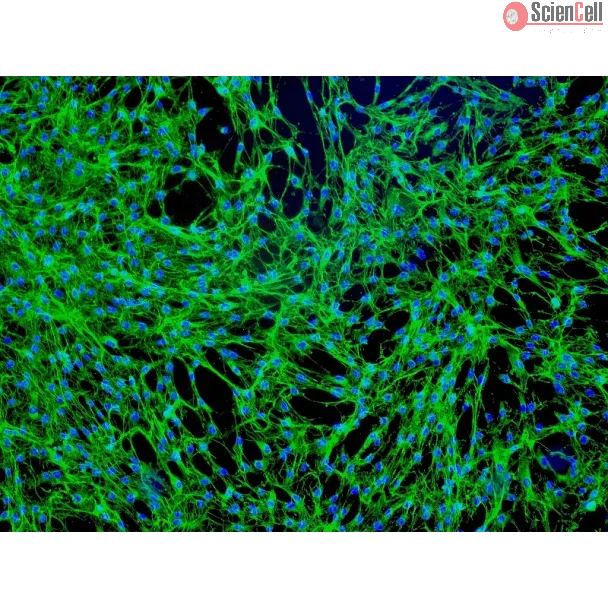
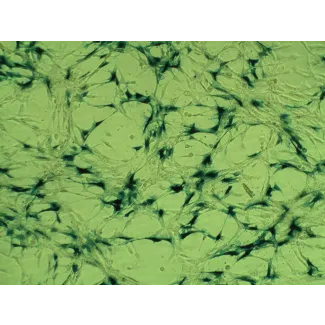
ScienCell Research Laboratories 的 HPrF 是从人类前列腺组织中分离获得的。HPrF 在第一代时进行冷冻保存,并以冷冻形式交付。每个小瓶含有超过 5 x 10⁵ 个细胞,体积为 1 毫升。HPrF 具有梭形形态,并通过针对纤维连接蛋白(fibronectin)的抗体免疫荧光鉴定。HPrF 经检测对 HIV-1、HBV、HCV、支原体、细菌、酵母菌和真菌均为阴性。在 ScienCell Research Laboratories 提供的条件下,HPrF 可保证继续增殖 15 代。
推荐培养基
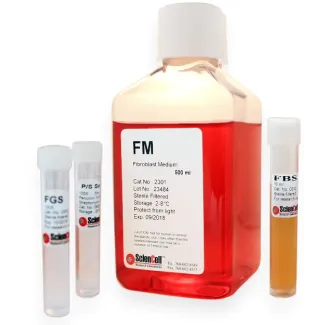
建议使用成纤维细胞培养基(Fibroblast Medium,FM,货号 #2301)在体外培养 HPrF。
Product Sheets
 4430
4430
Search for a Certificate of Analysis by Lot Number below:
The PIM1 oncogene is over-expressed in human prostate cancer epithelial cells. Importantly, we observe that in human hyperplastic and cancerous prostate glands PIM1 is al... More
The PIM1 oncogene is over-expressed in human prostate cancer epithelial cells. Importantly, we observe that in human hyperplastic and cancerous prostate glands PIM1 is also markedly elevated in prostate fibroblasts, suggesting an important role for this kinase in epithelial/stromal crosstalk. The ability of PIM1 to regulate the biologic activity of stromal cells is demonstrated by the observation that expression of PIM1 kinase in human prostate fibroblasts increases the level and secretion of the extracellular matrix molecule, collagen 1A1 (COL1A1), the pro-inflammatory chemokine CCL5, and the platelet-derived growth factor receptors (PDGFR). PIM1 is found to regulate the transcription of CCL5. In co-cultivation assays where PIM1 overexpressing fibroblasts are grown with BPH1 prostate epithelial cells, PIM1 activity markedly enhances the ability of these fibroblasts to differentiate into myofibroblasts and express known markers of cancer-associated fibroblasts (CAFs). This differentiation can be reversed by the addition of small molecule PIM kinase inhibitors. Western blots demonstrate that PIM1 expression in prostate fibroblasts stimulates the phosphorylation of molecules that regulate 5’Cap driven protein translation, including 4EBP1 and eIF4B. Consistent with the hypothesis that the kinase controls translation of specific mRNAs in prostate fibroblasts, we demonstrate that PIM1 expression markedly increases the level of COL1A1 and PDGFRβ mRNA bound to polysomes. Together these results point on PIM1 as a novel factor in regulation of the phenotype and differentiation of fibroblasts in prostate cancer by controlling both the transcription and translation of specific mRNAs. Less
Treatment options for late stage prostate and colon cancer are limited and there is an urgent need to develop more effective and targeted novel therapies, which starts wi... More
Treatment options for late stage prostate and colon cancer are limited and there is an urgent need to develop more effective and targeted novel therapies, which starts with identification and validation of novel therapeutic targets. Recent clinical studies have demonstrated that tissue inhibitor matrix metalloproteinase-1 (TIMP-1) levels are elevated in cancer patient plasma and elevated TIMP-1 levels are associated with worse clinical outcomes. However, it is unknown whether TIMP-1 serves merely as a biomarker of cancer progression or has a functional role in promoting cancer progression and can serve as a cancer therapeutic target, which is the main objective of this study. Here, we show that stroma of human prostate and colon cancer express higher levels of TIMP-1 compared to their normal counterparts and increased expression of TIMP-1 promotes in vivo growth of both cancer types. We demonstrate for the first time that increased TIMP-1 expression stimulates accumulation of cancer associated fibroblasts (CAFs) within prostate and colon cancer tissues and that TIMP-1 enhances prostate CAF proliferation and migration in vitro and promotes ERK1/2 kinase activation in these CAF cells. Our results establish the novel promotive effects of TIMP-1 on cancer progression and on accumulation of CAFs that in turn provides a pro-tumor microenvironment. Together, these results establish the potential of TIMP-1 as a novel target for cancer therapy and the mechanism underlying the pro-tumor activity of TIMP-1. Less
ScienCell Research Laboratories (SRL) takes pride in being a resource for researchers all over the world. The publications listed here are not meant as an endorsement or confirmation of the reliability of the products.