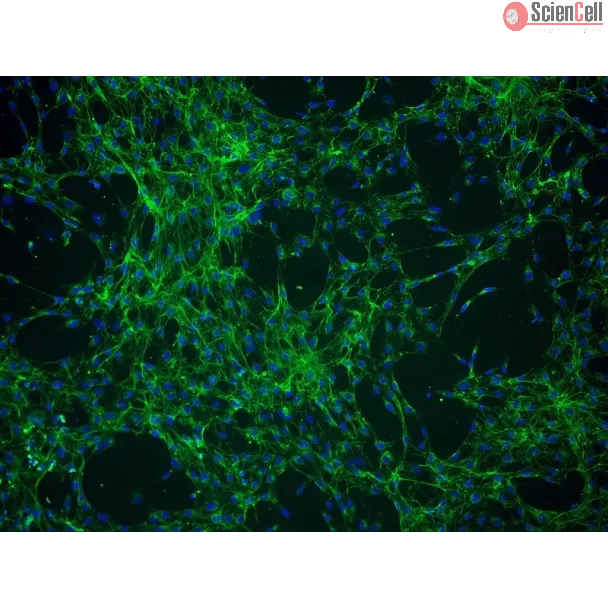
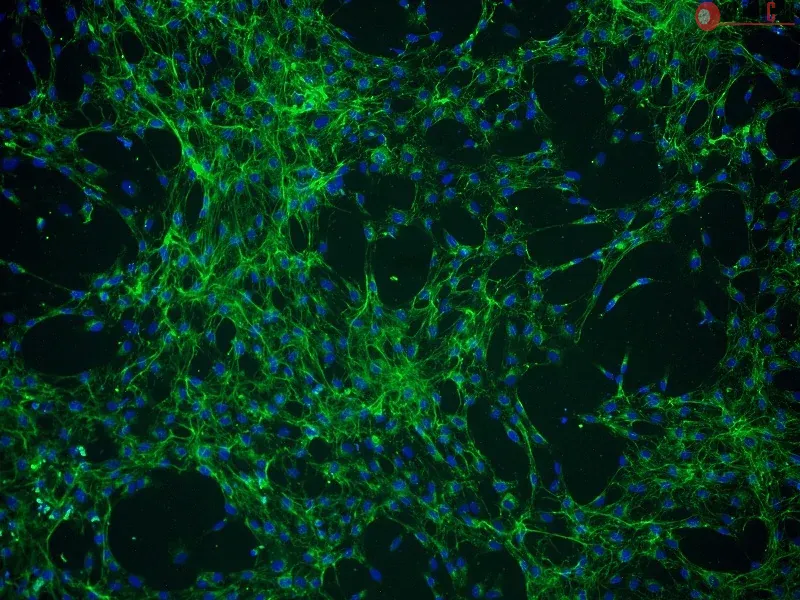
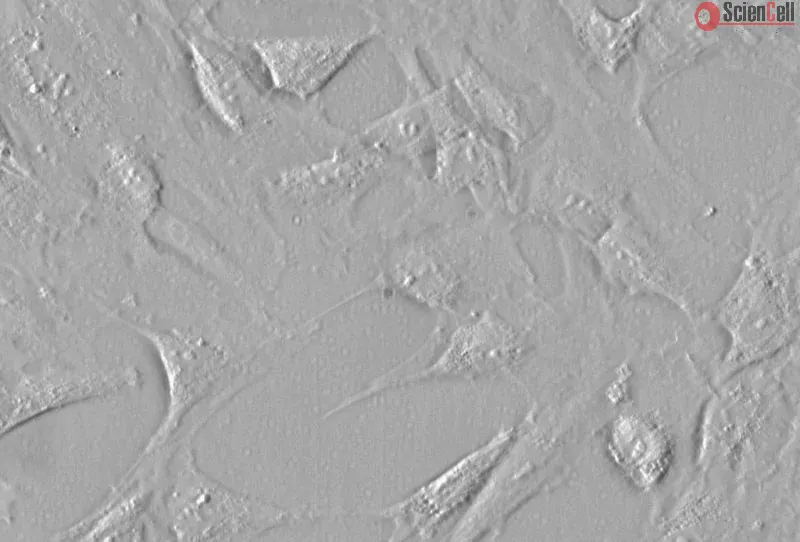
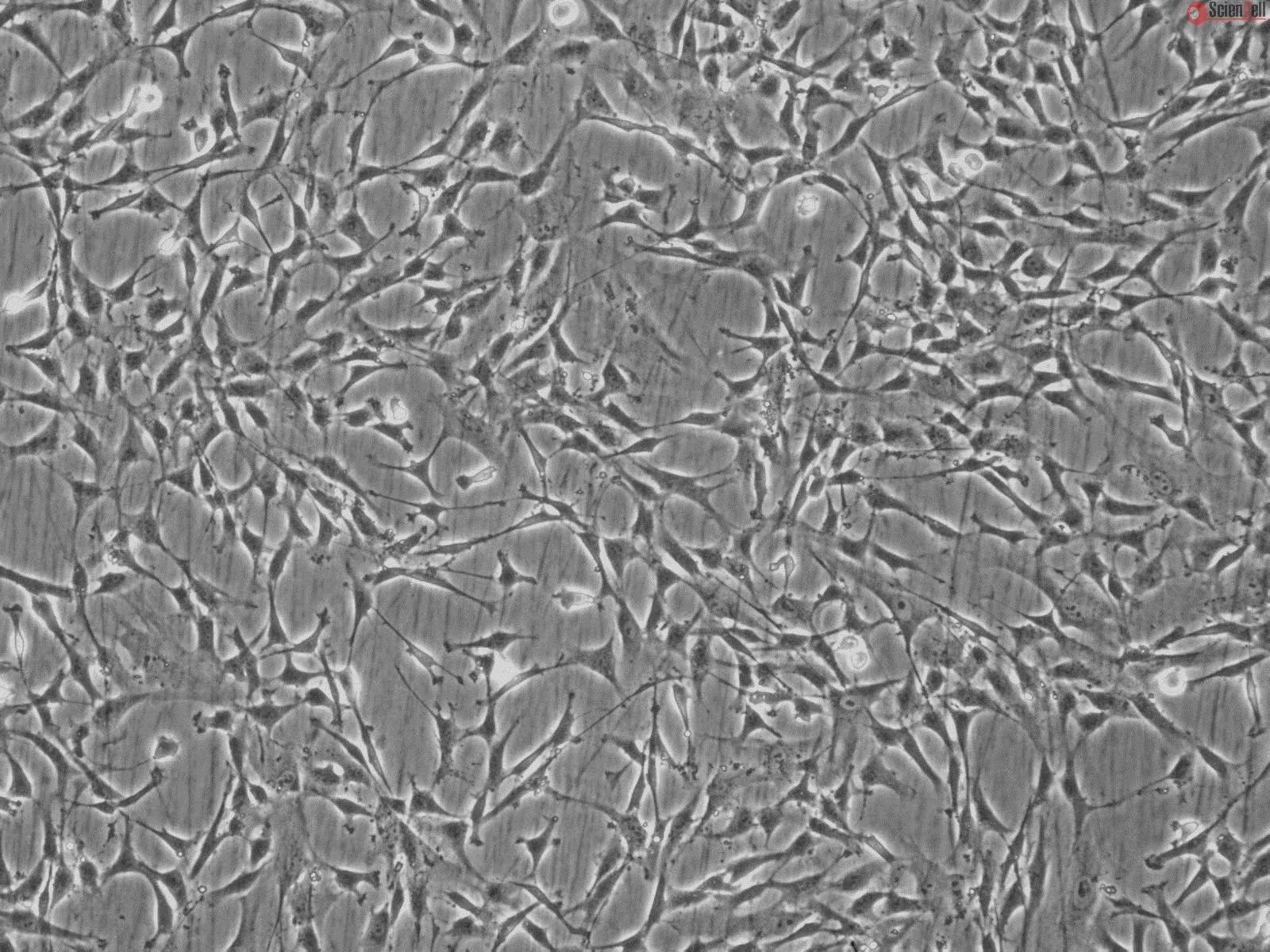
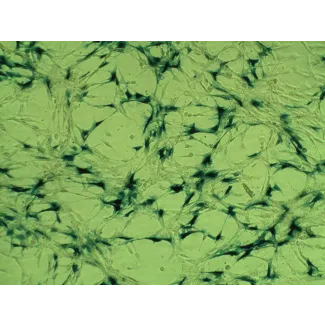
成纤维细胞是来源于胚胎中胚层的间充质细胞。一般来说,成纤维细胞分泌一种富含 I 型和/或 III 型胶原蛋白的非刚性细胞外基质。有证据表明,来自不同器官的成纤维细胞在本质上是不同的。由于成纤维细胞是最容易在培养中生长的细胞类型之一,因此被广泛用于各种细胞和分子研究。它们的耐久性使其适合进行多种操作,从基因转染到显微注射等研究。在之前的一项研究中,脉络丛成纤维细胞被用于研究巨噬细胞作为病毒靶细胞和病毒诱导因子在病毒-巨噬细胞-成纤维细胞相互作用中的角色。
来自 ScienCell Research Laboratories 的 HCPF 是从人类脉络丛分离的。HCPF 在第一代时被冷冻保存,并以冷冻状态交付。每瓶含有 >5 x 10⁵ 个细胞,体积为 1 毫升。HCPF 通过对特定于纤维连接蛋白的抗体进行免疫荧光标记进行表征。HCPF 对 HIV-1、HBV、HCV、支原体、细菌、酵母和真菌均为阴性。HCPF 在 ScienCell Research Laboratories 提供的条件下保证可进一步扩增 15 代。
推荐培养基
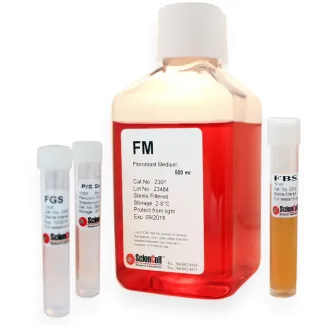
推荐使用成纤维细胞培养基(FM,产品编号 #2301)在体外培养 HCPF。
Product Sheets
 1320
Search for a Certificate of Analysis by Lot Number below:
Despite current central nervous system-directed therapies for childhood B-cell precursor acute lymphoblastic leukaemia, relapse at this anatomical site still remains a ch... More
Despite current central nervous system-directed therapies for childhood B-cell precursor acute lymphoblastic leukaemia, relapse at this anatomical site still remains a challenging issue. Few reports have addressed the study of the specific cellular microenvironments which can promote the survival, quiescence, and therefore chemoresistance of B-cell precursor acute lymphoblastic leukaemia cells in the central nervous system. Herein, we showed by immunofluorescence and electron microscopy that in xenotransplanted mice, leukaemic cells infiltrate the connective tissue stroma of the choroid plexus, the brain structure responsible for the production of cerebrospinal fluid. The ultrastructural study also showed that leukaemia cells are able to migrate through blood vessels located in the choroid plexus stroma. In short-term co-cultures, leukaemic cells established strong interactions with human choroid plexus fibroblasts, mediated by an increased expression of ITGA4 (VLA-4)/ITGAL (LFA-1) and their ligands VCAM1/ICAM1. Upon contact with leukaemia cells, human choroid plexus fibroblasts acquired a cancer-associated fibroblast phenotype, with an increased expression of α-SMA and vimentin as well as pro-inflammatory factors. Human choroid plexus fibroblasts also have the capacity to reduce the proliferative index of leukaemic blasts and promote their survival and chemoresistance to methotrexate and cytarabine. The inhibition of VLA-4/VCAM-1 interactions using anti-VLA-4 antibodies, and the blockade of Notch signalling pathway by using a γ-secretase inhibitor partially restored chemotherapy sensitivity of leukaemia cells. We propose that the choroid plexus stroma constitutes a sanctuary for B-cell precursor acute lymphoblastic leukaemia cells in the central nervous system. © 2020 The Authors. The Journal of Pathology published by John Wiley & Sons, Ltd. on behalf of The Pathological Society of Great Britain and Ireland. Less
Due to tumor heterogeneity, most believe that effective treatments should be tailored to the features of an individual tumor or tumor subclass. It is still unclear, howev... More
Due to tumor heterogeneity, most believe that effective treatments should be tailored to the features of an individual tumor or tumor subclass. It is still unclear, however, what information should be considered for optimal disease stratification, and most prior work focuses on tumor genomics. Here, we focus on the tumor microenvironment. Using a large‐scale coculture assay optimized to measure drug‐induced cell death, we identify tumor–stroma interactions that modulate drug sensitivity. Our data show that the chemo‐insensitivity typically associated with aggressive subtypes of breast cancer is not observed if these cells are grown in 2D or 3D monoculture, but is manifested when these cells are cocultured with stromal cells, such as fibroblasts. Furthermore, we find that fibroblasts influence drug responses in two distinct and divergent manners, associated with the tissue from which the fibroblasts were harvested. These divergent phenotypes occur regardless of the drug tested and result from modulation of apoptotic priming within tumor cells. Our study highlights unexpected diversity in tumor–stroma interactions, and we reveal new principles that dictate how fibroblasts alter tumor drug responses. Less
ScienCell Research Laboratories (SRL) takes pride in being a resource for researchers all over the world. The publications listed here are not meant as an endorsement or confirmation of the reliability of the products.