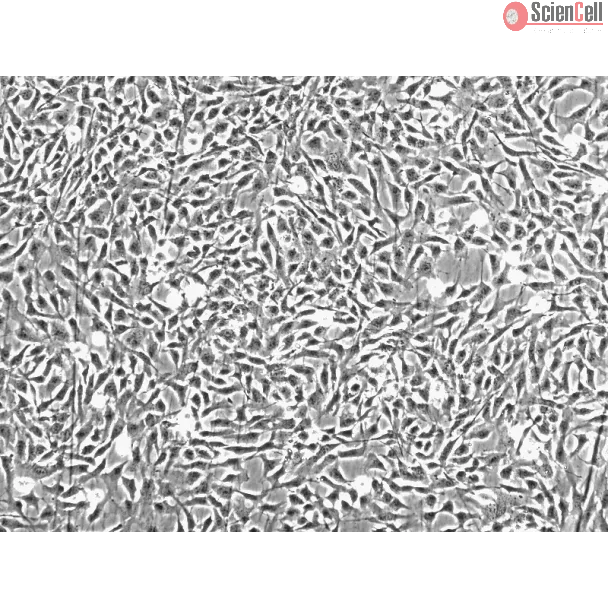
软骨细胞是软骨的常驻细胞,负责合成一系列胶原质和非胶原质的细胞外基质大分子。包括 II 型胶原、聚集蛋白、连接蛋白、IX 型胶原和 XI 型胶原。软骨细胞增殖和分化的调控对于脊椎动物骨骼的协调发展至关重要。软骨细胞能够产生并响应大量的肽类生长因子和细胞因子,包括胰岛素样生长因子-1和白介素-1。软骨细胞培养在体外模型中有助于研究软骨再生和修复、细胞因子与生长因子对软骨的影响、特定基因调控及关节炎的病理生理。
ScienCell Research Laboratories 的 HC-a 是从人类关节软骨中分离的。HC-a 在第一个传代时进行冷冻保存并以冷冻状态交付。每个小瓶含有超过 5 x 10⁵ 个细胞,体积为 1 毫升。HC-a 通过特异性抗体对 S100B 和/或 II 型胶原的免疫荧光染色进行表征。HC-a 对 HIV-1、HBV、HCV、支原体、细菌、酵母和真菌为阴性。HC-a 保证在 ScienCell Research Laboratories 提供的条件下,能进一步扩展 15 个代次。
推荐培养基
建议使用软骨细胞培养基 (CM, Cat. #4651) 来培养 HC-a 细胞。
Product Sheets
 4650
4650
Search for a Certificate of Analysis by Lot Number below:
Osteoarthritis (OA) is characterized by degradation of the cartilage matrix, leading to pathologic changes in the joints. However, the pathogenic effects of synovial tiss... More
Osteoarthritis (OA) is characterized by degradation of the cartilage matrix, leading to pathologic changes in the joints. However, the pathogenic effects of synovial tissue inflammation on OA knees are not clear. To investigate whether the inflammation caused by the medial plica is involved in the pathogenesis of osteoarthritis, we examined the expression of matrix metalloproteinases (MMPs), tissue inhibitors of metalloproteinases (TIMPs), interleukin (IL)-1β, and tumor necrosis factor (TNF)-α in the medial plica and pannus-like tissue in the knees of patients with medial compartment OA who underwent either arthroscopic medial release (stage II; 15 knee joints from 15 patients) or total knee replacement (stage IV; 18 knee joints from 18 patients). MMP-2, MMP-3, MMP-9, IL-1β, and TNF-α mRNA and protein levels measured, respectively, by quantitative real-time PCR and Quantibody human MMP arrays, were highly expressed in extracts of medial plica and pannus-like tissue from stage IV knee joints. Immunohistochemical staining also demonstrated high expression of MMP-2, MMP-3, and MMP-9 in plica and pannus-like tissue of stage IV OA knees and not in normal cartilage. Some TIMP/MMP ratios decreased significantly in both medial plica and pannus-like tissue as disease progressed from stage II to stage IV. Furthermore, the migration of cells from the pannus-like tissue was enhanced by IL-1β, while plica cell migration was enhanced by TNF-α. The results suggest that medial plica and pannus-like tissue may be involved in the process of cartilage degradation in medial compartment OA of the knee. Less
Background In addition to treating acute promyelocytic leukemia, arsenic trioxide (ATO) suppresses other solid tumors, including chondrosarcoma. However, the effects of A... More
Background In addition to treating acute promyelocytic leukemia, arsenic trioxide (ATO) suppresses other solid tumors, including chondrosarcoma. However, the effects of ATO on metastasis in chondrosarcoma cells, and the underlying molecular mechanisms remain unclear. Methods The effects of ATO on the migratory and invasive capacities of chondrosarcoma cells were investigated by Wound healing, Transwell and EMT assays. The expression of miR-125b in human chondrosarcoma tissues and cell lines was detected by real-time PCR analysis. Bisulfite sequencing analysis (BSP) was used to detect the effects of ATO on the expression of miR-125b. The gain-of-function and loss-of-function experiments were performed on chondrosarcoma cell lines to investigate the effects of miR-125b on chondrosarcoma invasion, and to determine whether signal transducer and activator of transcription 3(Stat3) mediates these effects. Dual-luciferase reporter assay was used to identify whether Stat3 is a direct target of miR-125b. Results MiR-125b was significantly downregulated in human metastatic chondrosarcoma tissues and cell lines but not in non-metastatic chondrosarcoma tissues. ATO up-regulates the expression of miR-125b by the demethylation of DNA. ATO induces MET and attenuates the invasive capacities of chondrosarcoma cells through miR-125b. Stat3 was verified as a direct target of miR-125b, which is involved in ATO regulating EMT-associated traits. Conclusions These findings, for the first time, provides evidence that the miR-125b-mediated inhibition of Stat3 is involved in the ATO-induced attenuation of metastasis in chondrosarcoma cells. Less
ScienCell Research Laboratories (SRL) takes pride in being a resource for researchers all over the world. The publications listed here are not meant as an endorsement or confirmation of the reliability of the products.