
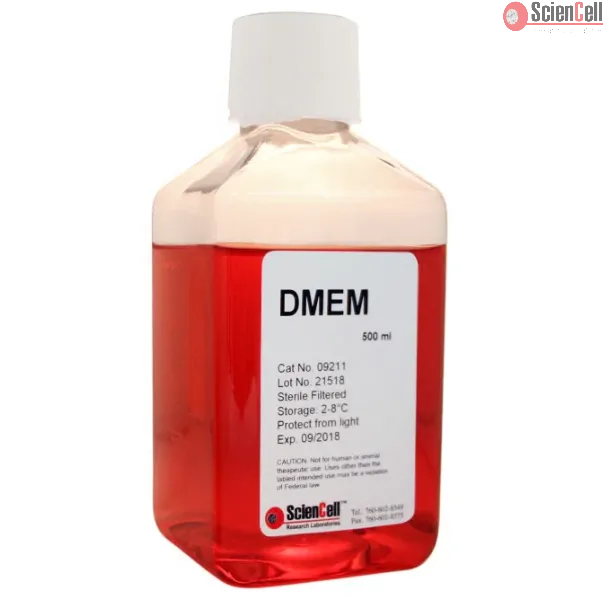
DMEM with L-Glutamine and Sodium Pyruvate
DMEM with L-Glutamine and Sodium Pyruvate (DMEM) is for research use only. It is not approved for human or animal use, or for application in in vitro diagnostic procedures.
There will be an additional 8% custom fee applied to this product.
This product requires a minimum purchase of 20 Bottles and a 3 week estimated time of arrival.
Please contact sales@sciencellonline.com to place an order.
Related Promotion:

Get 20% off with code Fall20
*Select products only. Mention the code at checkout; discount applied to invoice.Many modifications of eagle's medium have been developed since the original formulation. The most widely used modification is Dulbecco's Modified Eagle's Medium, which was developed in 1969. Dulbecco's Modified Eagle's Medium with L-Glutamine and sodium pyruvate (DMEM) is a modification of Basal Medium Eagle (BME) that contains a higher concentration of vitamins and amino acids, as well as additional supplementary components. DMEM with L-glutamine and sodium pyruvate is well suited for supporting the growth of a broad range of mammalian cell lines.
| 目录编号 | 09211 |
|---|---|
| 制造国家 | 美国 |
| 产品编码 | DMEM |
| 规格/数量 | 500 mL |
| 产品用途 | 本产品仅供研究使用。未经批准,不得用于人体、动物或体外诊断程序。 |
| 储存 | 将培养基储存在 4°C,避免光照。 |
| 运输 | 室温。 |
Product Sheets

Search for a Certificate of Analysis by Lot Number below:
Find answers to common questions about ScienCell products, cell culture, handling, and research applications.
ScienCell Research Laboratories (SRL) takes pride in being a resource for researchers all over the world. The publications listed here are not meant as an endorsement or confirmation of the reliability of the products.