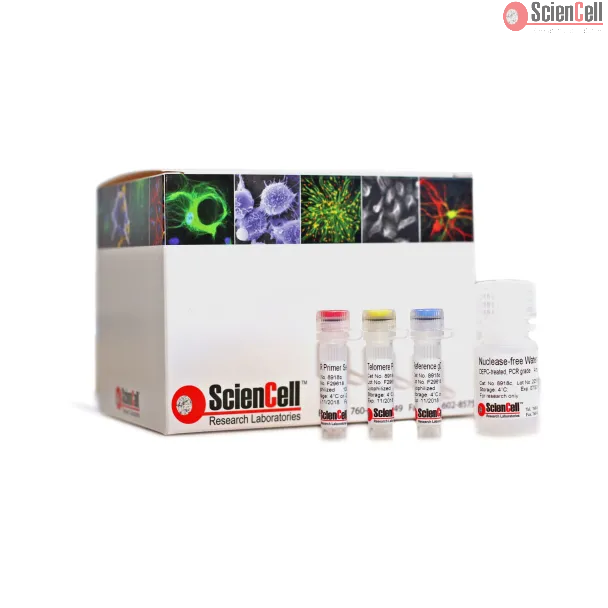
Telomeres are repetitive nucleotide elements at the ends of chromosomes that protect chromosomes from degradation and genetic information loss. Normal diploid cells lose telomeres with each cell cycle. Telomere length, therefore, decreases over time and may predict lifespan. Telomere shortening has negative effects on health conditions and has been linked to many health issues including aging and cancer. Accurate and consistent quantification of telomere length is important in many aspects of cell biology such as chromosomal instability, DNA repair, senescence, apoptosis, cell dysfunctions, and oncogenesis.
ScienCell's Absolute Mouse Telomere Length Quantification qPCR Assay Kit (AMTLQ) is designed to directly measure the average telomere length of a mouse cell population. The telomere primer set recognizes and amplifies telomere sequences. The single copy reference (SCR) primer set recognizes and amplifies a 100 bp-long region on mouse chromosome 10, and serves as reference for data normalization. The reference genomic DNA sample with known telomere length serves as a reference for calculating the telomere length of target samples. The carefully designed primers ensure: (i) high efficiency for trustworthy quantification; and (ii) no non-specific amplification. Each primer set has been validated by qPCR with melt curve analysis and gel electrophoresis for amplification specificity and by template serial dilution for amplification efficiency.
Background Herbal medicines are popular approaches to capably prevent and treat obesity and its related diseases. Excessive exposure to dietary lipids causes oxidative st... More
Background Herbal medicines are popular approaches to capably prevent and treat obesity and its related diseases. Excessive exposure to dietary lipids causes oxidative stress and inflammation, which possibly induces cellular senescence and contribute the damaging effects in brain. The potential roles of selective enhanced ginsenoside in regulating high fat diet (HFD)-induced brain damage remain unknown. Methods The protection function of Ginsenoside F1-enhanced mixture (SGB121) was evaluated by in vivo and in vitro experiments. Human primary astrocytes and SH-SY5Y cells were treated with palmitic acid conjugated Bovine Serum Albumin, and the effects of SGB121 were determined by MTT and lipid uptake assays. For in vivo tests, C57BL/6J mice were fed with high fat diet for 3 months with or without SGB121 administration. Thereafter, immunohistochemistry, western blot, PCR and ELISA assays were conducted with brain tissues. Results and conclusion SGB121 selectively suppressed HFD-induced oxidative stress and cellular senescence in brain, and reduced subsequent inflammation responses manifested by abrogated secretion of IL-6, IL-1β and TNFα via NF-κB signaling pathway. Interestingly, SGB121 protects against HFD-induced damage by improving mitophagy and endoplasmic reticulum-stress associated autophagy flux and inhibiting apoptosis. In addition, SGB121 regulates lipid uptake and accumulation by FATP4 and PPARα. SGB121 significantly abates excessively phosphorylated tau protein in the cortex and GFAP activation in corpus callosum. Together, our results suggest that SGB121 is able to favor the resistance of brain to HFD-induced damage, therefore provide explicit evidence of the potential to be a functional food. Less
The main source of error in gene expression is messenger RNA decoding by the ribosome. Translational accuracy has been suggested on a purely correlative basis to positive... More
The main source of error in gene expression is messenger RNA decoding by the ribosome. Translational accuracy has been suggested on a purely correlative basis to positively coincide with maximum possible life span among different rodent species, but causal evidence that translation errors accelerate aging in vivo and limit life span is lacking. We have now addressed this question experimentally by creating heterozygous knock-in mice that express the ribosomal ambiguity mutation RPS9 D95N, resulting in genome-wide error-prone translation. Here, we show that Rps9 D95N knock-in mice exhibit reduced life span and a premature onset of numerous aging-related phenotypes, such as reduced weight, chest deformation, hunchback posture, poor fur condition, and urinary syndrome, together with lymphopenia, increased levels of reactive oxygen species-inflicted damage, accelerated age-related changes in DNA methylation, and telomere attrition. Our results provide an experimental link between translational accuracy, life span, and aging-related phenotypes in mammals. Less
The gut microbiota is increasingly recognized as an important regulator of host immunity and brain health. The aging process yields dramatic alterations in the microbiota... More
The gut microbiota is increasingly recognized as an important regulator of host immunity and brain health. The aging process yields dramatic alterations in the microbiota, which is linked to poorer health and frailty in elderly populations. However, there is limited evidence for a mechanistic role of the gut microbiota in brain health and neuroimmunity during aging processes. Therefore, we conducted fecal microbiota transplantation from either young (3–4 months) or old (19–20 months) donor mice into aged recipient mice (19–20 months). Transplant of a microbiota from young donors reversed aging-associated differences in peripheral and brain immunity, as well as the hippocampal metabolome and transcriptome of aging recipient mice. Finally, the young donor-derived microbiota attenuated selective age-associated impairments in cognitive behavior when transplanted into an aged host. Our results reveal that the microbiome may be a suitable therapeutic target to promote healthy aging. Less
ScienCell Research Laboratories (SRL) takes pride in being a resource for researchers all over the world. The publications listed here are not meant as an endorsement or confirmation of the reliability of the products.