
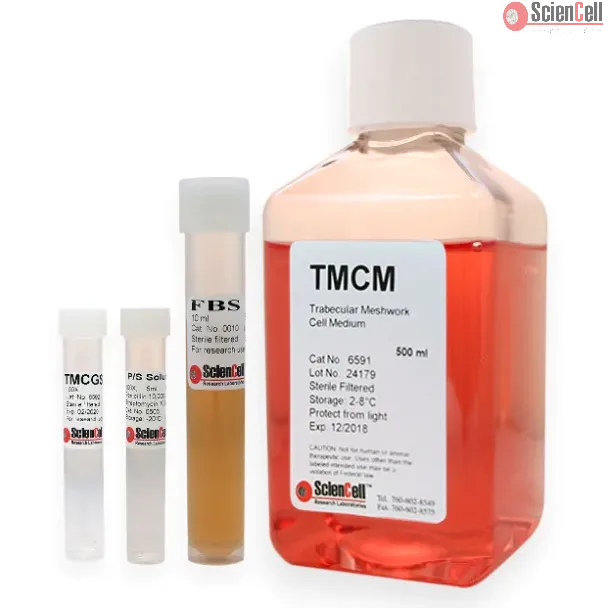
Trabecular Meshwork Cell Medium
Trabecular Meshwork Cell Medium (TMCM) consists of 500 ml of basal medium, 10 ml of FBS (Cat. #0010), 5 ml of Trabecular Meshwork Cell Growth Supplement (TMCGS, Cat. #6592) and 5 ml of penicillin/streptomycin solution (P/S, Cat. #0503).
Trabecular Meshwork Cell Medium (TMCM), when used with Trabecular Meshwork Cell Growth Supplement (TMCGS, Cat #6592) and 10 ml of fetal bovine serum (FBS) is a complete medium designed for optimal growth of normal trabecular meshwork cells in vitro. It is a sterile, liquid medium which contains essential and non-essential amino acids, vitamins, organic and inorganic compounds, hormones, growth factors, trace minerals and a low concentration of fetal bovine serum (2%). The medium is HEPES and bicarbonate buffered and has a pH of 7.4 when equilibrated in an incubator with an atmosphere of 5% CO2/95% air. The medium is formulated (quantitatively and qualitatively) to provide an optimally balanced nutritional environment that selectively supports the growth of normal trabecular meshwork cells in vitro.
| Catalog No. | 6591 |
|---|---|
| Product Code | TMCM |
| Size/Quantity | 500 ml |
| Product use | This product is for research use only. It is not approved for use in humans, animals, or in vitro diagnostic procedures. |
| Storage | Store the basal medium at 4°C, the TMCGS, the FBS and the P/S solution at -20°C. Protect from light. |
| Shipping | Basal medium: room temperature. Supplements: dry ice. |
Product Sheets
 6591-b-prf (Basal & Phenol Red Free Medium)
6591-prf (Complete Phenol Red Free Medium)
Search for a Certificate of Analysis by Lot Number below:
Write Your Own Review
Purpose: To evaluate the therapeutic efficacy of an adeno-associated virus serotype DJ (AAV-DJ) vector delivering MYOC-targeting short-hairpin RNA (shMYOC) in a MYOCP370... More
Background A traditional Chinese medicine, Tetramethylpyrazine (TMP), has been prescribed as a complementary treatment for glaucoma to improve patient prognosis. However,... More
ScienCell Research Laboratories (SRL) takes pride in being a resource for researchers all over the world. The publications listed here are not meant as an endorsement or confirmation of the reliability of the products.