
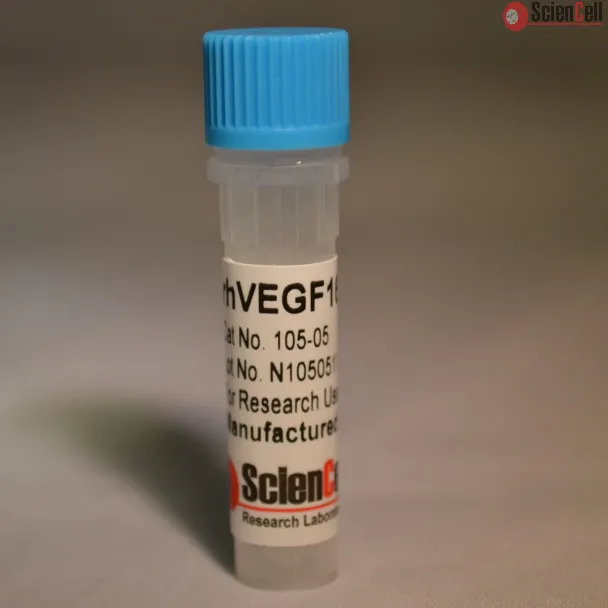
Recombinant Human VEGF165
Recombinant Human VEGF165 (rhVEGF165) product is for research use only. It is not approved for use in humans, animals, or in vitro diagnostic procedures.
VEGF is a potent growth and angiogenic cytokine. It stimulates proliferation and survival of endothelial cells, and promotes angiogenesis and vascular permeability. Expressed in vascularized tissues, VEGF plays a prominent role in normal and pathological angiogenesis. Substantial evidence implicates VEGF in the induction of tumor metastasis and intra-ocular neovascular syndromes. VEGF signals through the three receptors; fms-like tyrosine kinase (flt-1), KDR gene product (the murine homolog of KDR is the flk-1 gene product) and the flt4 gene product.
| Catalog No. | 105-05 |
|---|---|
| Product Code | rhVEGF165 |
| Country of Manufacture | United States or China |
| Size/Quantity | 2ug, 10ug, 1mg |
| Product use | This product is for research use only. It is not approved for use in humans, animals, or in vitro diagnostic procedures. |
| Storage | Store at -20°C after receiving. Upon reconstitution, store at 2-8°C for up to one week. For maximal stability, aliquot and store at -20°C. Avoid repeated freeze/ thaw cycles. |
| Shipping | Dry ice. |
| AA Sequence | APMAEGGGQN HHEVVKFMDV YQRSYCHPIE TLVDIFQEYP DEIEYIFKPS CVPLMRCGGC CNDEGLECVP TEESNITMQI MRIKPHQGQH IGEMSFLQHN KCECRPKKDR ARQENPCGPC SERRKHLFVQ DPQTCKCSCK NTDSRCKARQ LELNERTCRC DKPRR |
| Source | Escherichia coli |
| Molecular Weight | Approximately 38.2 kDa disulfide-linked homodimeric protein consisting of two 165 amino acid polypeptide chains. |
| Purity | >95% by SDS-PAGE and HPLC analyses. |
| Biological Activity | Fully biologically active. The ED50 is 1-8ng/ml, as determined by HUVEC cell proliferation. |
| Physical Appearance | White lyophilized powder. |
| Formulation | Lyophilized from a 0.2μm filtered solution in PBS, pH 7.4. |
| Endotoxin | < 1EU/μg of growth factor as determined by LAL method. |
| Reconstitution | Reconstitute in sterile distilled water containing 0.1% BSA to a concentration of 0.1-1.0 mg/mL. |
Product Sheets

Search for a Certificate of Analysis by Lot Number below:
Find answers to common questions about ScienCell products, cell culture, handling, and research applications.
No Publication available at this time.