
Recombinant Human Activin A
Activin A belongs to the superfamily of TGF-beta cytokines. Activin A works to stimulate the synthesis and secretion of follicle-stimulating hormone (FSH) proteins.
Activin A belongs to the superfamily of TGF-beta cytokines. Activin A works to stimulate the synthesis and secretion of follicle-stimulating hormone (FSH) proteins. Activins are involved in many biological activities like cell proliferation, differentiation, apoptosis, immune responses, and endocrine functions. Activins are homodimers or heterodimers of two beta subunits. Activins are closely related to Inhibins in that Inhibins having one beta subunit and one alpha subunit. Human Activin A shares 100% amino acid sequence identity with bovine, mouse, and rat Activin A. Recombinant human Activin A is a homodimer of two beta A subunits, each containing 116 amino acid residues.
| Catalog No. | 108-24 |
|---|---|
| Country of Manufacture | United States |
| Product Code | rhActivinA |
| Size/Quantity | 10 μg, 50 μg, 200 μg, |
| Product use | This product is for research use only. It is not approved for human or animal use, or for application in in vitro diagnostic procedures. |
| Storage | Upon receipt, store at -20 °C after receiving. Upon reconstitution, store at 2-8 °C for up to one week. For maximal stability, aliquot and store at -20 °C. Avoid repeated freeze/ thaw cycles. |
| Shipping | Gel Pack |
| Synonyms | Inhibin beta-A, Erythroid Differentiation Factor (EDF), follicle-stimulating hormone (FSH)-releasing protein |
| AA Sequence | GLECDGKVNICCKKQFFVSFKDIGWNDWIIAPSGYH ANYCEGECPSHIAGTSGSSLSFHSTVINHYRMRGHSP FANLKSCCVPTKLRPMSMLYYDDGQNIIKKDIQNMI VEECGCS |
| Source | mammalian cell |
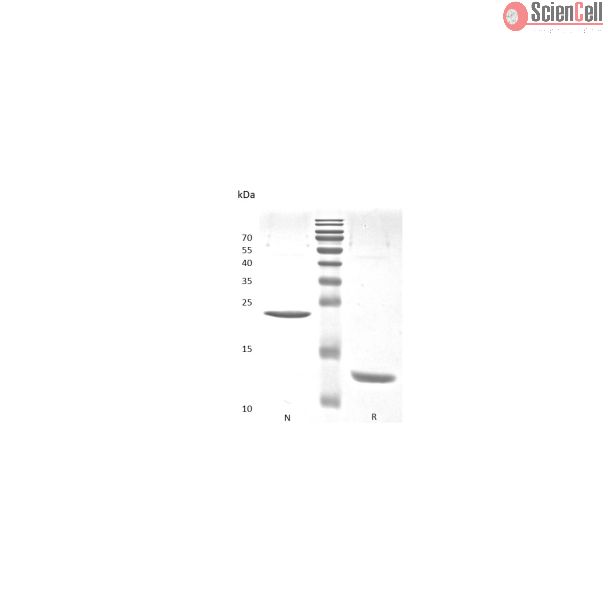
| Molecular Weight | 26 kDa, as a disulfide-linked homodimeric protein |
| Purity | > 95% |
| Physical Appearance | Light yellow to white powder |
| Formulation | Lyophilized from a 0.2µm filtered solution in Tris-HCl, pH 8.0. |
| Endotoxin | <0.1 ng/μg of protein (<1 EU/μg) |
| Reconstitution | Reconstitute in sterile distilled water to a concentration of 0.1-0.5 mg/mL. |
No Publication available at this time.