-from-c57bl-6.webp)
-from-c57bl-6.webp)
-from-c57bl-6-1.webp)
-from-c57bl-6-2.webp)
Mouse Neurons-striatal (MN-s) from C57Bl/6
Isolated from embryonic day 14 C57Bl/6 mouse striatum. MN-s are cryopreserved at P0 and delivered frozen. Each vial contains >1 x 10⁶ cells in 1 ml volume.
The tissue of the central nervous system is made up of two classes of cells that may be broadly categorized as neurons and glia. Neurons are anatomic, functional, and trophic units of the brain. Neurons are dynamically polarized cells responsible for electrochemically transmitting information throughout the nervous system. Despite great variability in size and shape, all neurons share common morphological features, the key elements of a highly complex communication network. The striatum is an important region involved in decision making, reward, and motor control. Disruptions in striatal function underlie Parkinson’s and Huntington’s disease. Mouse neurons-striatal (MN-s) are a useful in vitro model for studying Parkinson’s disease, Huntington’s disease, addiction, and bipolar disorder.
MN-s from ScienCell Research Laboratories are isolated from embryonic day 14 C57Bl/6 mouse striatum. MN-s are cryopreserved at P0 and delivered frozen. Each vial contains >1 x 10⁶ cells in 1 ml volume. MN-s are characterized by immunofluorescence with antibodies specific to β-tubulin III. MN-s are negative for mycoplasma, bacteria, yeast, and fungi. MN-s are guaranteed to further culture under the conditions provided by ScienCell Research Laboratories; however, MN-s are not recommended for expanding or long-term cultures since the cells do not proliferate in culture.
Recommended Medium
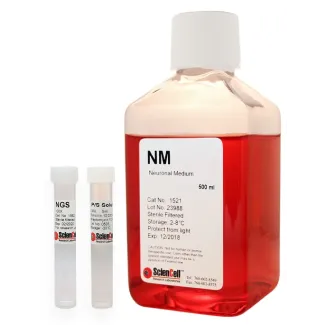
It is recommended to use Neuronal Medium (NM, Cat. #1521) for culturing MN-s in vitro.
| Catalog No. | M1560-57 |
|---|---|
| Country of Manufacture | United States |
| Product Code | MN-s |
| Size/Quantity | 1 x 10^6 cells/vial |
| Product use | MN-s are for research use only. They are not approved for human or animal use, or for application in in vitro diagnostic procedures. |
| Storage | Upon receiving, directly and immediately transfer the cells from dry ice to liquid nitrogen and keep the cells in liquid nitrogen until they are needed for experiments. |
| Shipping | Dry ice. |
No Publication available at this time.
,-1-mg-ml--2.jpg)