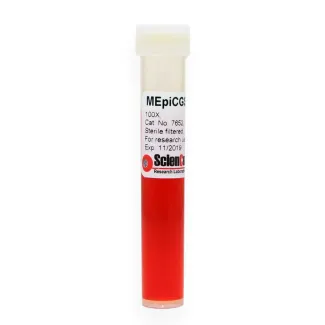
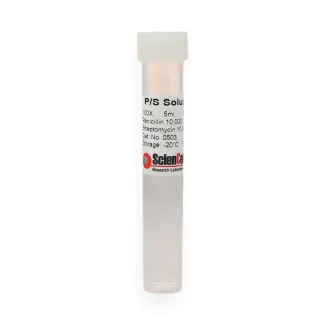
Mammary Epithelial Cell Medium (MEpiCM), when used with Mammary Epithelial Cell Growth Supplement (MEpiCGS, Cat #7652), is a complete medium designed for optimal growth of normal mammary epithelial cells in vitro. It is a sterile, liquid medium which contains essential and non-essential amino acids, vitamins, organic and inorganic compounds, hormones, growth factors and trace minerals. The medium is HEPES and bicarbonate buffered and has a pH of 7.4 when equilibrated in an incubator with an atmosphere of 5% CO2/95% air. The medium is formulated (quantitatively and qualitatively) to provide an optimally balanced nutritional environment that selectively supports the growth of normal mammary epithelial cells in vitro.
Breast cancer is the most common malignant disease in women, but some basic questions remain in breast cancer biology. To answer these, several cell models were developed... More
Breast cancer is the most common malignant disease in women, but some basic questions remain in breast cancer biology. To answer these, several cell models were developed. Recently, the use of improved cell-culture conditions has enabled the development of a new primary cell model with certain luminal characteristics. This model is relevant because, after the introduction of a specific set of genetic elements, the transformed cells yielded tumors resembling human adenocarcinomas in mice. The use of improved cell-culture conditions supporting the growth of these breast primary epithelial cells was expected to delay or eliminate stress-induced senescence and lead to the propagation of normal cells. However, no studies have been carried out to investigate these points. Propagation of breast primary epithelial cells was performed in WIT medium on Primaria plates. Immunofluorescence, western blot and qRT-PCR were used to detect molecular markers, and to determine the integrity of DNA damage-response pathways. Promoter methylation of p16 (INK4a) was assessed by pyrosequencing. In order to obtain a dynamic picture of chromosome instability over time in culture, we applied FISH methodologies. To better link chromosome instability with excessive telomere attrition, we introduced the telomerase reverse transcriptase human gene using a lentiviral vector. We report here that breast primary epithelial cells propagated in vitro with WIT medium on Primaria plates express some luminal characteristics, but not a complete luminal lineage phenotype. They undergo a p16-dependent stress-induced senescence (stasis), and the cells that escape stasis finally enter a crisis state with rampant chromosome instability. Chromosome instability in these cells is driven by excessive telomere attrition, as distributions of chromosomes involved in aberrations correlate with the profiles of telomere signal-free ends. Importantly, ectopic expression of the human TERT gene rescued their chromosomal instability phenotype. Essentially, our data show that contrary to what was previously suggested, improved culture conditions to propagate in vitro mammary epithelial cells with some luminal characteristics do not prevent stress-induced senescence. This barrier is overcome by spontaneous methylation of the p16 (INK4a) promoter, allowing the proliferation of cells with telomere dysfunction and ensuing chromosome instability. Less
Background: The aim of this study was to investigate the effects of poly-lactic-co-glycolic acid (PLGA) nanotopographies with alginate or chitosan protein preadsorption o... More
Background: The aim of this study was to investigate the effects of poly-lactic-co-glycolic acid (PLGA) nanotopographies with alginate or chitosan protein preadsorption on the functioning of healthy and cancerous lung and breast cells, including adhesion, proliferation, apoptosis, and release of vascular endothelial growth factor (VEGF), which promotes tumor angiogenesis and secretion. Methods: We used a well established cast-mold technique to create nanoscale surface features on PLGA. Some of the nanomodified PLGA films were then exposed to alginate and chitosan. Surface roughness and the presence of protein was confirmed by atomic force microscopy. Surface energy was quantified by contact angle measurement. Results: Nanostructured PLGA surfaces with 23 nm features decreased synthesis of VEGF in both lung and breast cancer cells compared with conventional PLGA. Preadsorbing alginate further decreased cancer cell function, with nanostructured PLGA preadsorbed with alginate achieving the greatest decrease in synthesis of VEGF in both lung and breast cancer cells. In contrast, compared with nonmodified smooth PLGA, healthy cell functions were either not altered (ie, breast) or were enhanced (ie, lung) by use of nanostructured features and alginate or chitosan protein preadsorption. Conclusion: Using this technique, we developed surface nanometric roughness and modification of surface chemistry that could selectively decrease breast and lung cancer cell functioning without the need for chemotherapeutics. This technique requires further study in a wide range of anticancer and regenerative medicine applications. Keywords: alginate; breast; cancer; chitosan; lung; nanotechnology. Less
Targeted delivery of drugs to tumors represents a significant advance in cancer diagnosis and therapy. Therefore, development of novel tumor-specific ligands or pharmaceu... More
Targeted delivery of drugs to tumors represents a significant advance in cancer diagnosis and therapy. Therefore, development of novel tumor-specific ligands or pharmaceutical nanocarriers is highly desirable. In this study, we utilized phage display to identify a new targeting peptide, SP90, which specifically binds to breast cancer cells, and recognizes tumor tissues from breast cancer patients. We used confocal and electron microscopy to reveal that conjugation of SP90 with liposomes enables efficient delivery of drugs into cancer cells through endocytosis. Furthermore, in vivo fluorescent imaging demonstrated that SP90-conjugated quantum dots possess tumor-targeting properties. In tumor xenograft and orthotopic models, SP90-conjugated liposomal doxorubicin was found to improve the therapeutic index of the chemotherapeutic drug by selectively increasing its accumulation in tumors. We conclude that the targeting peptide SP90 has significant potential in improving the clinical benefits of chemotherapy in the treatment and the diagnosis of breast cancer. Less
ScienCell Research Laboratories (SRL) takes pride in being a resource for researchers all over the world. The publications listed here are not meant as an endorsement or confirmation of the reliability of the products.

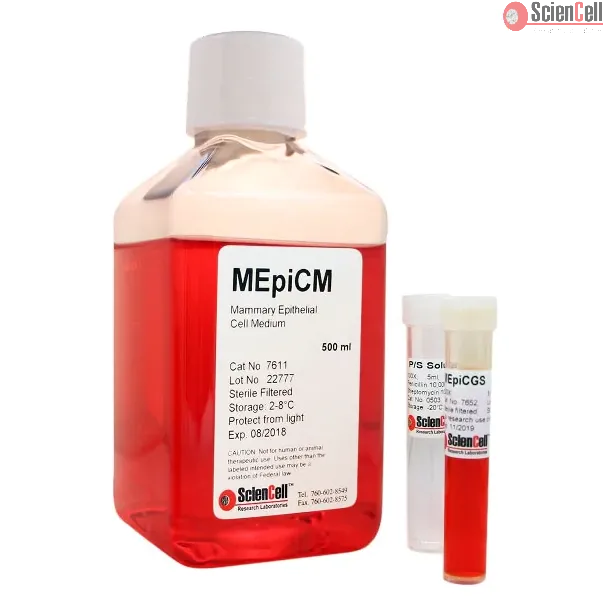
 7611-b-prf (Basal & Phenol Red Free Medium)